
Retail Theft Prevention: How Electronic Article Surveillance (EAS) and Security Tags Work
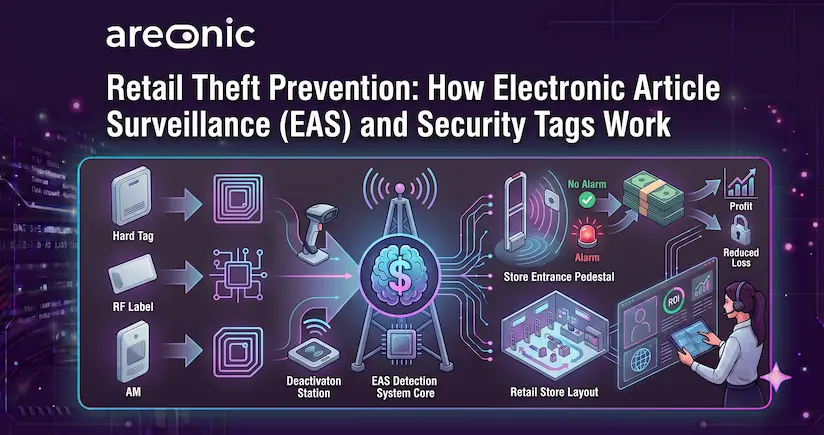
Retail shrinkage is now a measurable line on the P&L, driven less by casual shoplifting than by organized retail crime (ORC), return fraud, and coordinated theft that ordinary deterrents do not stop. The first engineered defense against it, electronic article surveillance, is fundamentally a physics problem: a resonant tag on the merchandise and an antenna at the door tuned to detect it. Understanding how eas security tags actually work, the frequencies they use and the locks that hold them, is the baseline for choosing retail theft prevention devices that fit a given store format. It is also the starting point for the newer question this guide addresses: what happens after the alarm sounds, and how computer vision closes the gap EAS leaves open.
The Engineering Behind EAS Security Tags and Electronic Article Surveillance
EAS security tags are electronic resonators, either adhesive labels or reusable hard tags, attached to merchandise so that a transceiver antenna at the store exit can detect any active tag passing through and sound an alarm. The system operates as a loop of three parts: the tag on the item, a deactivator or detacher at the point of sale that neutralizes or removes it at purchase, and the pedestal antennas that interrogate the exit for any tag still live.
Each component solves a distinct part of that loop. The tag itself is a passive resonator, an RF label being a printed planar LC circuit while an AM tag holds magnetostrictive metal strips that ring at a set frequency when energized. At the point of sale, an RF label is deactivated by detuning its circuit and a hard tag is physically released with a detacher, so a paid item crosses the threshold silently. The exit pedestals are paired transceiver antennas that flood the doorway with the system’s frequency and listen for a tag resonating back, raising the alarm when one does. The reliability of the entire system rests on that final step being sensitive enough to catch live tags yet selective enough to ignore deactivated ones.
Comparing Core Frequencies: Acousto-Magnetic (AM) vs. Radio Frequency (RF) vs. RFID
Frequency is the single biggest determinant of which retail theft prevention devices suit a store, because it dictates detection range, tag size, and how the tag behaves near metal and liquid.
- Radio Frequency (RF), 8.2 MHz: The general-merchandise and apparel standard, using lightweight planar LC circuit labels that are inexpensive at volume and easy to apply to flat packaging. RF’s weakness is physical: metallic surfaces and foil shield the label, which is precisely why booster bags are built to defeat RF systems.
- Acousto-Magnetic (AM), 58 kHz: Uses magnetostrictive amorphous metal strips that vibrate under a pulsed magnetic field, giving stronger detection around liquids, foils, and metals and across wider exits. That resilience makes AM the standard for cosmetics, pharmacy, and wide-entrance department stores.
- RFID (UHF, 860 to 960 MHz): A hybrid model in which serialized tags provide theft deterrence and real-time, SKU-level stock visibility at once, so the tag that guards an item also reports where it is. RFID inventory tracking is why many retailers now run loss prevention and inventory management as a single program.
Types of Physical Tags: Protecting Apparel and High-Value Assets
Beyond the resonator inside it, a tag’s physical form factor determines what it can protect and how hard it is to defeat.
- Anti theft tags for clothing: Hard-shell tags secured by a magnetic-clutch locking pin, ranging from a standard magnetic lock to a multi-pole super-lock rated 12,000 GS and above that resists common detachers. Many add a visual ink ampoule that shatters and stains the garment if the tag is forced, while delicate fabrics use lightweight lanyard tags to avoid pin holes.
- Specialized clothing alarm tags: Self-alarming 2-alarm and 3-alarm tags that emit a high-decibel siren on their own if the lanyard is cut, if the tag crosses an EAS gate, or if a tampered item is carried past the store perimeter. The onboard alarm removes the dependency on the pedestal being the only point of detection.
- Spider wraps and keeper boxes: High-security enclosures for boxed electronics and luxury cosmetics that wrap an item in alarmed cabling or seal it in a locked case, sounding a built-in siren if the cable is severed without the authorized magnetic key.
Bridging EAS Alarms with Areonic AI Video Analytics
EAS answers exactly one question, whether a live tag is leaving the store, and stays silent on every other. It cannot say who set off the pedestal, what they carried, or whether the beep was a theft or a cashier’s deactivation error, which is why a lone alarm so often ends in an awkward, unwinnable confrontation at the door. Areonic’s Sensor Fusion engine supplies the missing context by tying the alarm to the picture.
The immediate fix is visual verification. When a pedestal triggers, Areonic links that event through an open API to the overhead camera covering the exit and clips high-resolution footage of the specific person passing through during the alarm window. Staff see who and what before deciding whether to approach, and a deactivation error becomes obvious rather than a false accusation.
The deeper value is catching what EAS cannot sense at all. Foil-lined booster bags exist specifically to defeat tag detection, and sweet-hearting, a cashier deliberately fake-scanning items for an accomplice, never trips a tag alarm in the first place. Areonic’s computer vision reads the behavior instead of the tag, delivering automated ai retail theft detection by flagging concealment patterns at the shelf and scan anomalies at the register independently of any pedestal signal, which is where most organized and internal loss actually occurs.
None of this requires replacing the EAS estate. Where traditional providers wall retailers into a proprietary portal, Areonic unifies existing pedestals, POS transaction logs, and ONVIF cameras in one dashboard, so the hardware already on the floor becomes the input to a smarter layer rather than a sunk cost.
Operational ROI: Transforming Loss Prevention into Profit Protection
Integrating physical tags with intelligent software turns loss prevention from a cost of doing business into a measurable protector of margin. The returns arrive from three directions.
Shrinkage falls first and most directly. Pairing tag-level deterrence with video that confirms every alarm raises the real risk of theft for ORC crews and cuts the write-offs from both external theft and internal sweet-hearting, without adding floor staff.
Checkout speed improves as a second-order gain. Automated POS deactivators that neutralize tags within the scan motion remove the manual step that slows lanes and irritates customers, so security stops trading against throughput.
Recovery and prosecution improve last. When a theft does occur, court-admissible video carrying a precise timestamp, tied to the exact alarm event, turns a vague incident report into evidence that supports both recovery and charges. Deterrence, speed, and provable evidence together convert loss prevention into genuine profit protection.
Conclusion
Electronic article surveillance remains the backbone of retail asset protection, but its physics define its ceiling: a tag and an antenna can signal that something live is leaving, and nothing more. The frequency a store chooses, RF, AM, or RFID, and the tags it locks onto merchandise determine how well that backbone performs, yet all of them share the same blind spot at the instant the alarm sounds. Areonic removes that blind spot by fusing pedestal events with overhead video, verifying every alarm, catching the booster-bag and sweet-hearting tactics that tags miss, and doing it on the EAS and camera hardware a store already owns. Loss prevention teams modernizing their defenses can request a technical architecture briefing to map the integration onto their existing pedestals, POS, and cameras.