Business Security Solutions Playbook: Modern Building Access Control Architecture
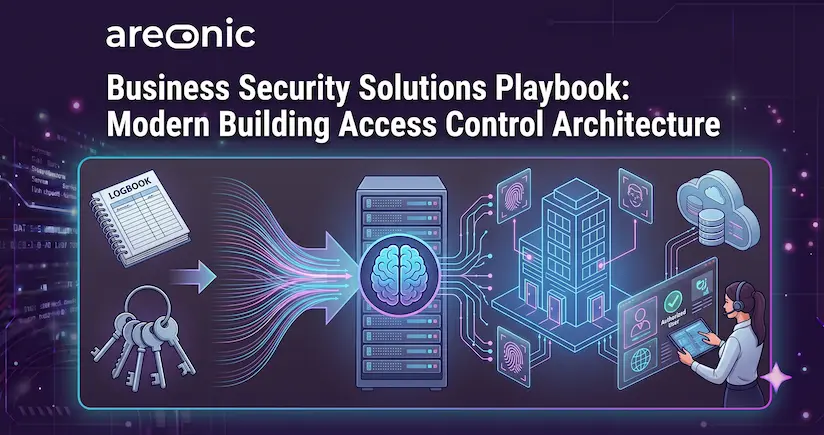
Commercial buildings have become harder to secure precisely as they have grown more flexible. Hybrid schedules mean the population on a floor changes hour to hour, multi-tenant churn constantly reshuffles who belongs where, and security systems that run in isolation, badges here, cameras there, a visitor log at a desk, leave gaps between them that no single system owns. Modern building access control systems exist to close those gaps by unifying credential verification, identity governance, and monitoring into one architecture. This playbook lays out that architecture tier by tier, the deployment strategies that fit real office hubs, and where office access control systems still leave blind spots that only visual verification can cover.
The Architectural Anatomy of Commercial Building Access Control Systems
Building access control systems are the integrated hardware and software that authenticate who may enter a space and record every entry, spanning the readers at the door, the controllers that make the access decision, and the platform that governs credentials centrally. A modern deployment is defined less by the lock than by how those three tiers communicate: encrypted reader protocols, edge controllers that stay live when the network does not, and directory sync that keeps permissions accurate as people join and leave.
- The credential and reader tier: High-security contactless smart card readers communicate over encrypted, bi-directional OSDP v2 rather than legacy Wiegand, and accept mobile digital credentials over BLE and NFC alongside encrypted smart cards such as DESFire EV3. Moving off Wiegand closes the skimming and cloning exposure that one-way, unencrypted card signaling leaves wide open.
- The intelligent edge controller tier: Network-native sub-controllers sit near each door cluster and run authorization logic locally, so a valid badge still opens its door if the upstream link drops. That edge placement is what gives commercial access control architecture its offline continuity rather than a hard dependency on a central server.
- The central management and directory integration tier: A cloud-native or on-premise governance platform synchronizes user profiles directly with identity providers such as Okta, Microsoft Entra ID, and Google Workspace over SCIM, so identity directory sync drives access instead of manual list-keeping.
Read together, the three tiers describe a system in which the reader proves a credential, the edge controller enforces the decision even in isolation, and the directory keeps the entire population current. A weakness in any one tier, an unencrypted reader, a controller with no local cache, or a directory updated by hand, quietly undermines the other two. That interdependence is why modern commercial deployments have to be evaluated as an integrated stack rather than as a lock bolted to a badge.
The Enterprise Access Playbook: Deployment Strategies for Modern Office Hubs
Architecture is only useful once it maps to how a building actually moves people. Three deployment patterns cover most commercial office hubs.
- Multi-tenant perimeter and turnstile ingress: Optical turnstiles paired with high-throughput mobile readers move hundreds of employees through a lobby per minute without forming a bottleneck, while keeping each tenant’s population cleanly separated, which is the core of multi-tenant property governance in a shared building. Adding elevator destination dispatch routes riders by credential, so access rules extend vertically through the building rather than stopping at the front door.
- Automated visitor and contractor provisioning: QR-code registration workflows replace the manual front-desk logbook, issuing temporary, time-fenced credentials scoped strictly to the floors and conference rooms a guest is cleared for. This visitor management integration turns a paper trail into an auditable digital record that expires on its own schedule.
- Zero-trust internal partitioning: Sensitive zones such as server rooms, executive suites, and R&D labs are gated with multi-factor authentication, combining a card or mobile credential with facial recognition surveillance or a PIN pad, so a single lost badge never grants entry to the highest-value spaces.
Eliminating Blind Spots: Unifying Office Access Control Systems with Areonic
A card reader is a binary oracle: it confirms that a credential is valid and knows nothing else about the moment of entry. That single limitation accounts for most of the residual risk left in otherwise well-built office access control systems, and it is exactly where Areonic’s Sensor Fusion engine adds the layer readers cannot provide.
Tailgating is the clearest example. A reader authenticates one badge, but it cannot see the second person who slips through behind an authorized employee. Areonic’s computer vision models analyze the entry vector in real time and reconcile the badge scan against a visual person count, flagging the mismatch the moment a piggybacking event happens rather than surfacing it in a later audit, if at all. That is a class of tailgating detection the credential layer is structurally blind to.
Interoperability is the second gap Areonic closes. Proprietary platforms, LenelS2 hardware setups among them, tend to bind an enterprise to specific controller boards and tiered licensing that make each addition a negotiation. Areonic sits above that as a hardware-agnostic layer, pairing with any standard access system and ONVIF-compliant camera network, so the visual intelligence never requires ripping out the access hardware already in place.
The third gain is speed of proof. When an access system raises a “door forced open” or “invalid badge attempt” alert, the usual next step is a manual hunt through camera feeds for the matching timestamp. Areonic indexes access logs directly against video metadata, so the exact clip for that event returns in under two seconds, turning a raw alert into verified evidence without the scrubbing.
Maximizing Security ROI and Operational Capital Efficiencies
An integrated access architecture pays back most visibly through the costs it removes rather than the features it adds. The largest is identity drift. When access is driven by SCIM sync to the HR directory, a departing employee is de-provisioned across every door the moment their record is disabled, which eliminates the standing risk and administrative drag of unreturned physical keycards that legacy systems never fully reclaim.
Staffing is the next line. Automated visitor kiosks and QR provisioning reduce or remove the front-desk headcount previously needed to register and escort guests, and they do it while producing a cleaner audit trail than a manual log ever did. A recurring labor cost becomes a one-time configuration.
Network and maintenance overhead falls on the same principle. Open, software-driven management replaces per-seat licensing and proprietary appliances with a platform that runs on existing infrastructure, so expanding coverage is a configuration change rather than a hardware purchase. Across a multi-site portfolio, predictable licensing and lower maintenance compound into a materially lower total cost of ownership. Consolidated access and video logs also shorten compliance work, since audit evidence is pulled from one correlated record instead of assembled from separate systems after the fact.
Conclusion
Modern building security is won at the seams: in the space between a valid badge and what the camera actually saw, and between a directory change and the door that should honor it. A well-built architecture closes those seams by design, with encrypted readers, edge controllers that survive an outage, directory-driven identity, and deployment patterns matched to how each building moves people. Areonic completes the loop by fusing access events with live video, so tailgating, forced doors, and invalid attempts are verified visually the moment they occur rather than reconstructed hours later. Facility and security leaders building or upgrading this stack can request a technical architecture briefing to map the playbook onto their existing readers, controllers, and cameras.
Frequently Asked Questions (FAQ)