How Much Does a Commercial Security System Actually Cost? Pricing Breakdown and ROI
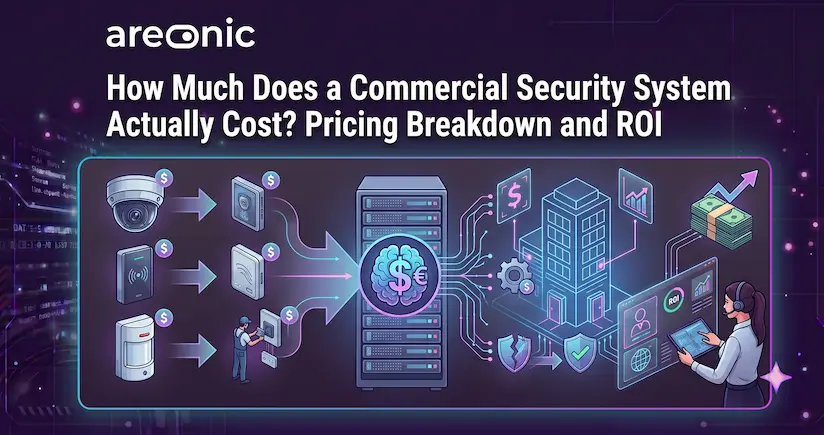
The quote a vendor hands you is almost never the number you pay. A commercial security system’s advertised price covers cameras and a recorder, and then the real commercial security systems cost accumulates in the line items underneath: per-camera software licenses billed annually, low-voltage cabling labor at $75 to $150 an hour, and hardware renewal cycles that force a repurchase every few years. Answering how much is a security system for a business honestly means modeling a multi-year total cost of ownership, not a first-year invoice. This guide breaks the spend into its real components, compares the three deployment models on cost, and shows where a software-driven approach removes entire categories of expense.
The Core Financial Pillars: Understanding Commercial Security Systems Cost
A commercial security system typically costs a business between $8,000 and $25,000 upfront for a mid-sized deployment of roughly 16 to 32 cameras, plus recurring software or monitoring fees that vary sharply by architecture. The real figure depends less on the cameras themselves than on cabling labor, storage retention, and whether the platform charges per-camera licenses, which is why a headline quote rarely reflects the true multi-year total cost of ownership.
Those totals resolve into three financial categories that behave very differently over time: upfront capital, one-time installation labor, and recurring operating costs. Modeling all three is the only way to compare vendors on a like-for-like basis.
Upfront Hardware and Infrastructure (CapEx)
Hardware is the most visible cost and the easiest to scope. Fixed dome or bullet IP cameras run roughly $150 to $600 per unit, specialized multi-sensor or PTZ cameras $800 to $2,500 or more, and thermal optics for perimeters $2,000 to $5,000 and up. Storage is the next block: network video recorders, evaluating options like a Cloud NVR, or on-premise recording servers with enterprise surveillance drives range from $1,000 to $10,000 or more depending on RAID configuration and retention length. Network infrastructure, managed PoE and PoE+ switches, Cat6 cabling, patch panels, and UPS backup, typically adds $500 to $3,000. These are CapEx line items, paid once but subject to renewal on the vendor’s cycle.
Security System Installation Cost for Business Deployments
Labor is where estimates drift most. The security system installation cost for business sites is driven by low-voltage technician rates, commonly $75 to $150 or more per hour, and by cabling: pulling plenum-rated cable through occupied commercial real estate averages $150 to $300 per drop, and the drop count scales with the camera count. Beyond the physical pull, commissioning adds hours that quotes routinely understate, network configuration, IP subnetting, focusing each camera, and integration with access control or a building management system. PoE cabling labor rates and drop counts, not the cameras, are frequently the largest single surprise in a first deployment.
Recurring Operational Costs (OpEx)
Recurring fees are what separate a cheap first year from an expensive decade. Legacy VMS and analytics licensing often charges $50 to $150 per camera channel upfront and then a mandatory annual software maintenance agreement on top, so per-camera licensing fees compound with every camera added. Pure cloud systems replace that with a monthly charge of roughly $10 to $30 per camera, which looks modest until it is multiplied across dozens of cameras and several years, and which also drives up WAN bandwidth. These recurring monitoring fees, whether software maintenance or cloud subscription, are the line that decides the real NVR vs cloud total cost of ownership.
Evaluating Business Security Systems Cost: On-Premise vs. Cloud vs. Hybrid
With the components priced, the architecture decision is really a decision about where the cost lands: upfront, monthly, or spread. Three models frame the business security systems cost trade-off.
- Traditional on-premise: Highest upfront CapEx, since local server racks, storage arrays, and manual IT patching are all bought and owned, but recurring cloud and bandwidth costs stay minimal. It suits organizations that prefer to capitalize security, keep data local, and can staff the maintenance.
- Pure cloud-native: Lowest upfront hardware footprint, which is attractive on day one, but recurring OpEx climbs fast, with per-camera monthly fees that escalate past a 50-camera install and heavy monthly WAN data strain. The cheap entry becomes the expensive decade.
- Hybrid software-driven (the Areonic model): The most capital-efficient of the three. Heavy processing runs on local edge compute using existing hardware, and only lightweight metadata travels to the central console, so bandwidth and subscription costs stay low while upfront hardware is minimized. The cost is neither front-loaded nor perpetually metered.
The Areonic Advantage: Slashing Deployment and Maintenance Overhead
Every cost category above contains a component that traditional vendors treat as unavoidable and that a camera-agnostic software layer simply removes. Areonic changes the math rather than trimming it.
The first is the hardware rip-and-replace cost. Many providers make their own camera brand a condition of the platform, so adopting them means discarding a working fleet and buying theirs. Areonic runs as a fully camera-agnostic layer on existing ONVIF IP cameras and commodity servers, which keeps the single largest CapEx line, the cameras themselves, off the invoice entirely and delivers camera-agnostic savings as pure avoided spend.
Bandwidth is the second recurring drain. Continuous off-site video upload inflates the corporate uplink and, on metered links, the monthly bill along with it. Because Areonic executes machine learning locally and keeps full-resolution video on local arrays, routine operation consumes under one percent of network bandwidth, so the WAN never has to be upgraded to carry footage it rarely needs to move.
The third is a cost most budgets miss until it arrives: false alarm municipal fines. Nuisance alerts from legacy motion detection trigger emergency dispatches and private guard rolls that cost enterprises thousands a year, and many jurisdictions bill repeat false dispatches directly. Areonic’s computer vision and Sensor Fusion engines filter out up to 95 percent of those false alarms before anything is escalated, turning a recurring penalty into a non-event.
Measuring Return on Investment (ROI) Beyond Physical Asset Protection
The full return on a modern system is understated if it is scored only as theft prevention, because the analytics that protect assets also generate operational and legal value.
Shrinkage and theft reduction is the direct line. Continuous computer vision on inventory, cargo, and handoff points cuts the internal and external losses that quietly erode margin, and it does so without adding guard hours to the payroll.
Operational and safety optimization is the less obvious return. The platform tracks forklift traffic and worker density, enforces PPE compliance automatically, and surfaces workflow bottlenecks, turning the camera network into a stream of operational data the business would otherwise pay separately to collect.
Fraud and liability defense may be the fastest payback of all. When a slip-and-fall or a worker compensation claim is filed, timestamped video retrieved in seconds either confirms or disproves it, and a single defended fraudulent claim can offset a meaningful share of the system’s annual cost. Taken together, these three returns reframe security from a pure cost center into a measurable value driver.
Conclusion
The honest answer to what a commercial security system costs is that the sticker is the smallest part of it. Real spend lives in cabling labor, per-camera licensing, bandwidth, hardware renewals, and false alarm penalties, and those are the numbers that decide a multi-year total cost of ownership. A camera-agnostic, software-driven model attacks the largest of them directly, keeping existing cameras in service, holding bandwidth near zero, and filtering the false alarms that bill the business every year. Scored across several years and paired with its operational and liability returns, that architecture turns security from an escalating cost line into a controllable, even productive, investment. Teams building a budget can request a technical architecture briefing to model the total cost of ownership against their existing cameras and sites.