How to Migrate Industrial NVR/DVR Infrastructure to Cloud Surveillance Without Operational Downtime
Industrial sites run on surveillance hardware that is quietly failing. Aging NVR and DVR units record to local disks no one can search across sites, their unpatched operating systems sit exposed behind forwarded ports, and the vendor quote to replace them, cameras and coax and all, runs into six figures per facility. The result is that plants and distribution hubs stay chained to obsolete recorders because ripping them out looks worse than living with them. There is a third path: migrate to a hybrid cloud industrial security system that keeps the existing cameras and cabling, adds edge intelligence and cloud management on top, and does it without taking warehouse surveillance offline during the cutover. This guide is that migration, phase by phase.
The Industrial Bottleneck: Why Legacy NVRs and DVRs Fail Modern Warehouse Surveillance
Warehouse surveillance is the camera and analytics system that monitors a distribution or storage facility for theft, safety, and operational events across high-bay racking, docks, and yards. In industrial settings it has to work at a scale and durability consumer or SMB gear never faces: dozens to hundreds of cameras, cavernous sightlines, and network links shared with mission-critical operations.
Three failures make the legacy recorder untenable at that scale, and none is fixed by buying a newer recorder.
- Isolated storage silos and timeline scrubbing: DVRs and NVRs trap video on local disks, so a multi-facility incident audit means physically visiting each recorder or juggling separate site-by-site logins and scrubbing timelines by hand. There is no way to ask one question across the whole footprint.
- Cyber vulnerabilities of legacy hardware: Unpatched DVR and NVR operating systems reached through port forwarding or dynamic DNS expose the industrial control network to botnets and external penetration, turning a recorder into an entry point onto the OT network it should never touch.
- Bandwidth inefficiency in high-bay facilities: Streaming raw multi-camera feeds from a remote distribution hub back to a central monitoring team overloads the industrial uplink, which is already carrying warehouse management, scanning, and control traffic the business cannot slow down.
The 4-Step Migration Blueprint for an Enterprise Industrial Security System
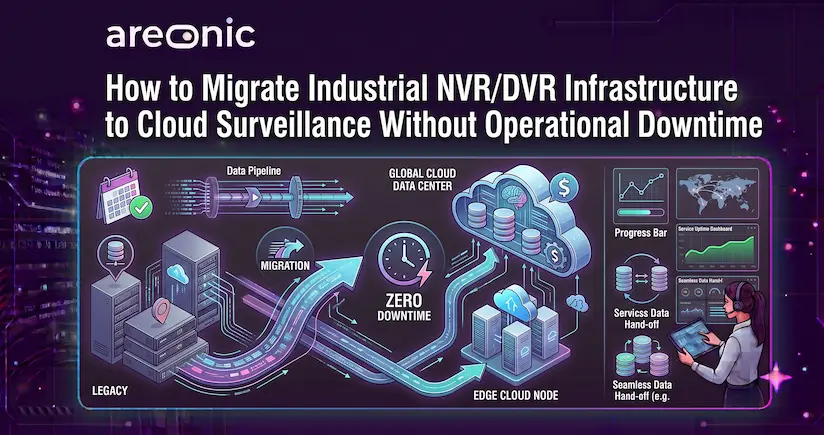
Migrating to a modern industrial security system does not require downtime if the new layer is built alongside the old one and cut over only once it is verified. The path runs in four phases, and the existing recorders keep running until the last of them.
- Phase 1, stream and topology ingestion audit: Document every camera endpoint to establish native ONVIF Profile S, G, and T compliance, direct RTSP URLs, and any legacy analog BNC connections still in service. The audit turns an unknown estate into a migration plan and changes nothing operationally.
- Phase 2, multi-channel digital bridge integration: Where cameras are analog, multi-port IP video encoders provide an effective way for Analog to cloud video surveillance by digitizing the coaxial signal into standard H.264 or H.265 RTSP at the rack, so the production floor is never rewired and the original coax stays in place. Analog-to-IP encoders extend the migration to the oldest cameras on site.
- Phase 3, deploying local edge software gateways: A lightweight software container installed on an existing commodity server or virtual machine on-site aggregates the streams and handles continuous local recording, running in parallel with the legacy recorder rather than replacing it on day one. This is where the cutover becomes safe, because both systems record until the new one is proven.
- Phase 4, establishing outbound zero-trust cloud telemetry: Outbound-only TLS 1.3 tunnels connect the local gateway to the cloud console, so cloud management arrives with no open inbound firewall port. Only after this layer is verified do the legacy NVRs come offline, making the transition a controlled handoff rather than an outage.
Run this way, the NVR/DVR cloud migration is a sequence of additive steps rather than a forklift swap: at no point is the site without recording, and the legacy hardware is retired only after the hybrid edge-to-cloud VMS has proven itself in parallel. That is what makes zero downtime a design property instead of a hope, and it is why the approach survives contact with a live, around-the-clock operation that cannot pause for a cutover weekend.
Edge vs. Cloud Ingestion: Solving the Industrial WAN Bandwidth Challenge
Industrial WANs are the tightest constraint in the whole migration, because a remote hub’s uplink is sized for operations, not for video. WAN bandwidth optimization here comes from not moving the video at all.
- Edge analytics execution: Computer vision models run locally on the edge gateway to detect perimeter intrusions, forklift and pedestrian hazards, and unauthorized dwell times, so the analysis happens on site rather than in a cloud that would need the raw feed. The intelligence is produced where the cameras are.
- Metadata-only telemetry streaming: Only structured JSON metadata and verified event clips travel to the central cloud platform, which cuts continuous WAN load by up to 90 percent and leaves the uplink free for the warehouse’s operational systems. The link carries conclusions, not footage.
- Resilience against network outages: Local capture, storage loops, and perimeter rules keep running through a remote-site ISP drop, so an outage degrades cloud reporting but never the recording or the on-site security itself. The facility is never blind because the internet blinked.
The pattern inverts the usual cloud-video assumption. Rather than treating the uplink as a pipe to fill with footage, it treats the edge as the place where video lives and the cloud as where decisions are coordinated, so a hub on a modest connection behaves the same as one on fiber. For a distributed operator, that consistency across wildly different site links is often worth more than any single feature.
The Areonic Advantage: Enterprise Modernization Without Hardware Rip-and-Replace
For an industrial operator, the objection to modernizing has always been the cost and risk of the change itself, not the value of the outcome. Areonic is built to remove that objection, on the three fronts that matter most to a plant or a distribution network.
The hardware already installed stays installed. Traditional cloud vendors require ripping out working cameras and cabling for proprietary devices, which is exactly the capital and disruption an industrial site cannot absorb. Areonic integrates with existing equipment to deliver robust commercial surveillance systems as a software layer over existing cameras, encoders, and network hardware, so modernization is an install rather than a demolition.
Investigation stops being site-by-site. Instead of logging into dozens of regional NVRs to scrub footage by hand, a security team runs one natural language query, for example “white box truck at loading dock 4 after midnight,” and Areonic returns the verified clip across every facility in under two seconds. Distributed multi-site facility management becomes a single search rather than a tour of recorders.
The cyber posture hardens as it modernizes. Areonic eliminates port forwarding with outbound-only TLS 1.3 tunnels, encrypts local archives with AES-256, and centralizes role-based access control through enterprise SSO, so connecting an industrial site to the cloud shrinks its attack surface instead of widening it, which matters most where the video network sits close to OT.
Conclusion
Industrial sites do not stay on failing NVRs because the technology is good; they stay because the cost and downtime of replacing it have looked worse than the risk of keeping it. A hybrid migration removes that dilemma: encoders digitize analog cameras at the rack, an edge gateway runs alongside the legacy recorder until it is proven, and outbound-only tunnels add cloud management without opening a port or rewiring a floor. Areonic delivers that path as camera-agnostic software that keeps full-resolution video and recording local, holds WAN load under one percent, and hardens the site as it connects it. Facility and security leaders can request a technical architecture briefing to map the migration onto their existing recorders, cameras, and network.