Restaurant Security & Operations: Mitigating Theft, Kitchen Hazards, and Front-of-House Risks
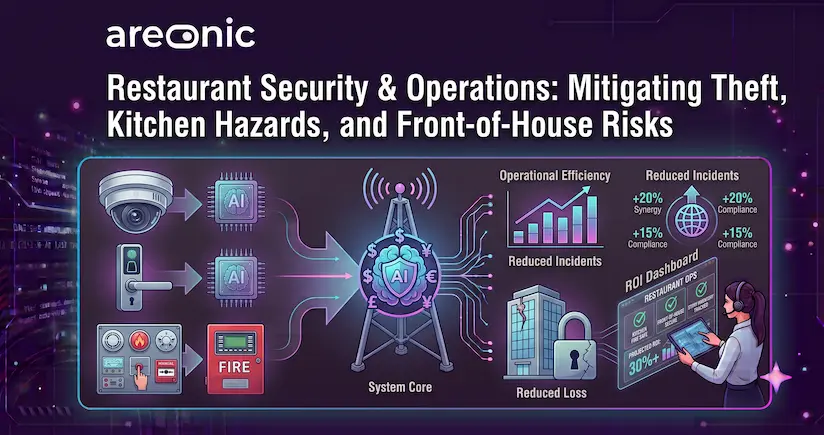
Restaurants operate on margins too thin to absorb the losses that fragmented security lets through. High employee turnover erodes accountability at the register, cash shrinkage disappears into voids and comps, grease and steam destroy hardware never built for a kitchen, and a single fraudulent slip-and-fall claim can cost more than a year of profit at one unit. A basic restaurant alarm system that only detects after-hours intrusion addresses almost none of this. What multi-unit operators need is an active, software-driven restaurant security system that watches the register, the kitchen, the cooler, and the dining room with hardware and analytics matched to each. This guide maps that system zone by zone, then the operational intelligence layered on top.
Strategic Facility Zonation: Designing a Restaurant Security System
A restaurant security system is an integrated layer of cameras, sensors, and access controls tuned to the specific risks of a food-service site, spanning cash handling at the register, grease and heat in the kitchen, cold-storage inventory, and liability exposure on the dining floor. Unlike a passive recorder reviewed only after an incident, a modern system actively correlates video with POS data and environmental telemetry so theft, hazards, and false claims are caught as they happen.
No single camera type or placement covers a restaurant, because its risks are spatially distinct: the register, the line, cold storage, and the floor each fail in different ways. Effective restaurant video surveillance treats them as four separate design problems.
Point of Sale (POS) and Bar Cash Drawers
The register and the bar well are where money moves fastest and shrinkage hides best, through register manipulation, unrecorded cash sales, short-changing, and bartender over-pouring. Coverage here demands resolution over breadth: a 4K or 8MP fixed dome mounted directly overhead, running wide dynamic range to survive high-contrast bar lighting, so footage resolves individual bill denominations and the line items on the screen. The goal is not to watch the cashier but to ensure automated POS fraud detection by making every transaction reconcilable against video.
Kitchen and Food Preparation Areas (Back-of-House)
The kitchen is an environmental problem before it is a security one. Airborne grease, steam, and high-heat washdowns will destroy ordinary cameras within a season, so back-of-house safety coverage requires IP66 or IP67 grease-resistant cameras with hydrophobic and oleophobic glass coatings that shed oil and wipe clean. Positioned over the line and prep stations, those cameras double as a food safety compliance record and a live hazard monitor for spills, blocked exits, and missing PPE.
Walk-In Coolers, Freezers, and Liquor Storage
Cold storage holds the highest-value inventory in the building, prime cuts and liquor, and its biggest loss vector is spoilage as much as theft. Wide-angle low-temperature cameras rated to run inside a freezer are paired with environmental IoT sensors, so walk-in cooler temperature monitoring becomes an automated alert the instant a unit drifts outside a safe range, rather than a discovery made at the next inventory count. Access to the liquor cage is logged alongside the same video.
Dining Floor, Hostess Stand, and Exterior Patios (Front-of-House)
Out front the dominant risk is liability, not theft. Fraudulent slip-and-fall claims are won or lost on whether continuous, unbroken footage of the floor exists, so front-of-house coverage favors discreet low-profile domes and 360-degree multi-sensor ceiling units that leave no blind spot a plaintiff can exploit. The same cameras manage guest flow at the hostess stand and secure patio perimeters after close.
Beyond Intrusion: Elevating the Standard Restaurant Alarm System
A restaurant alarm system earns its keep only when it manages operational triggers, not just break-ins. Three categories separate a modern system from a simple intrusion panel.
- Automated environmental and spoilage protection: Wireless IoT telemetry folded into the security layer watches for refrigeration failure, gas leaks, and early kitchen-hood flare-ups around the clock, so a compressor failing at 2 a.m. pages a manager instead of spoiling a cooler of product by morning.
- Time-fenced back-door access control: Delivery bays and kitchen exits run on scheduled access rules, and a door propped open during a night shift, a classic route for walkout theft, raises an immediate alert rather than going unnoticed until inventory turns up short.
- Automated POS transaction-video sync: Register events that signal fraud, voids, comps, zero-dollar sales, and refunds, are linked directly to the time-synchronized clip of the moment they were rung, which makes sweethearting and drawer skimming visible instead of buried in a transaction log.
The Areonic Edge: Software-Driven Intelligence for Multi-Unit Hospitality
Single-site tools do not scale to a restaurant group, and that gap is what Areonic is built for. As a camera-agnostic software layer, it turns whatever hardware each location already runs into one coherent operation.
For a multi-unit operator, the platform decision is really a fleet decision. Legacy providers sell branded hardware bundles that make every new location a fresh purchase and every acquired location a rip-out. Areonic unifies existing ONVIF IP cameras and POS terminals across regional and franchise sites into a single pane of glass, so a group runs one system rather than one per building.
The clearest single payback is liability defense. When a guest files a fraudulent slip-and-fall or food-poisoning claim, the usual response is a manager losing hours scrubbing timelines across the relevant shift. Areonic’s natural language metadata indexing lets an operator query a plain description, for example “customer near table 12 at 8 PM,” and export the verified clip in under two seconds, which is frequently the difference between settling and winning.
Bandwidth is a quieter constraint, and in a restaurant it carries an unusual twist: surveillance competes with the guest Wi-Fi. Streaming several high-resolution feeds to the cloud congests the same network customers are using. Areonic runs its machine learning locally at the edge and keeps high-resolution video on local arrays, using under one percent of network bandwidth for central management, so the cameras never degrade the guest experience they are partly there to protect.
Maximizing Hospitality ROI and Compliance
An integrated restaurant video surveillance platform pays for itself along four lines that map directly to a restaurant P&L.
Liability defense is the largest and least predictable of them. A single fraudulent claim defeated with timestamped video can offset years of platform cost, and the mere existence of unbroken footage discourages opportunistic claims before they are ever filed.
Food waste is the steadiest. IoT refrigeration tracking tied to the security layer catches temperature excursions early, preventing the spoiled-inventory write-offs a manual cooler check finds too late, and the same telemetry supports HACCP-aligned food safety compliance records.
Compliance and shrinkage close the case. Automated review turns kitchen health and safety audits from periodic scrambles into continuous, logged monitoring, while POS-video sync eliminates the cash drawer shrinkage that quietly drains a high-turnover front of house. Across a multi-unit group, those four returns compound into materially protected operating margin.
Conclusion
Restaurant security fails when it is treated as a burglar alarm bolted onto a business that actually loses money at the register, in the cooler, and on the dining floor. A system designed for hospitality zones each of those risks deliberately: overhead resolution at the POS, grease-proof cameras on the line, temperature telemetry in cold storage, and blind-spot-free coverage out front. Areonic ties all of it together as camera-agnostic software that overlays POS data on video, folds in environmental sensors through its Sensor Fusion engine, and runs across every unit in a group from one console with no proprietary lock-in. Operators managing a multi-unit footprint can request a technical architecture briefing to map the system onto their existing cameras, POS, and sites.