Hybrid Cloud Architecture in Enterprise CCTV: Solving On-Premise Constraints and WAN Saturation
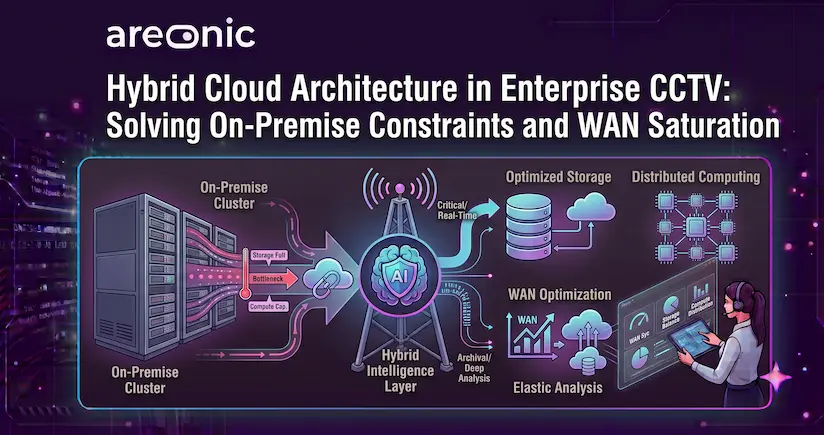
Enterprise CCTV forces an architectural choice that neither option wins cleanly. Pure on-premise keeps every 4K stream on the local switch fabric, which is fast and private but leaves each site a hardware silo that has to be patched, port-forwarded, and refreshed on its own. Pure cloud centralizes management into a browser but pays for it in bandwidth, pushing continuous high-bitrate video across the WAN and metering every camera by the month. Deploying an enterprise cloud security system at scale means refusing that binary: the workable path is an edge-intelligent hybrid where compute stays local and only results travel. Modern cloud based security camera systems for business earn their value precisely by decoupling video processing from centralized transmission, and this guide lays out the network and cost math behind why.
The Structural Dilemma: Analyzing Pure Cloud Security System Topologies vs. On-Premise Silos
A cloud security system is a surveillance architecture that manages cameras, storage, analytics, and access through a cloud-hosted platform rather than a self-contained local recorder, administered from a browser. In its purest form all video travels off-site for processing and storage, which is what makes it flexible to manage and, at enterprise scale, expensive to feed across a wide-area network.
Both architectures are internally coherent; each simply optimizes for the opposite constraint. Understanding where each one breaks is the prerequisite for a hybrid that keeps the strengths of both.
On-Premise NVR/VMS Deployments: Hardware Silos and Air-Gapped Overhead
A traditional on-premise deployment centralizes recording on NVR racks or dedicated servers running proprietary VMS software against local RAID storage. All ingestion stays on the LAN over RTSP and ONVIF, so continuous recording never depends on an internet link, which is the model’s genuine strength and the reason it also satisfies strict local retention compliance. Its weaknesses are operational: remote access requires punching holes in the firewall through port forwarding or reverse proxies, OS and VMS patching is manual and per-site, and there is no unified visibility across a distributed estate. Each facility becomes an island that must be maintained on its own.
Pure Cloud VSaaS: Centralized Processing and Outbound Network Choke
Video Surveillance as a Service (VSaaS) inverts the model, sending raw video upstream from direct-to-cloud cameras or lightweight bridges into multi-tenant data centers where storage and analytics live. Management is unified and browser-based, and there is no local server to maintain. The cost lands in a different place: transmission is continuous and upstream, so the WAN carries full-bitrate video around the clock, live monitoring and recording depend entirely on internet uptime, and the subscription meter runs every month per camera. The convenience is real, and so is the bandwidth bill behind it.
The Bandwidth Choke: Evaluating WAN Saturation in Pure Cloud Security Solutions
The case against pure cloud at enterprise scale is arithmetic, not opinion. Video is heavy, and the WAN is finite.
- Continuous upstream saturation: A single 4K camera under H.264 or H.265 compression needs roughly 4 to 8 Mbps of sustained upload, so a 50-camera site drives 200 to 400 Mbps of permanent upstream demand even with adaptive bitrate streaming (ABR) trimming quieter scenes. That load competes directly with the SaaS, ERP, and VoIP traffic the business actually runs on, and the resulting WAN uplink saturation degrades all of them at once.
- Forensic playback and latency overhead: Pure cloud makes investigation expensive in the other direction. Pulling several camera angles at once for a review drags heavy downstream bitstreams back through the same link, producing latency, dropped frames, and buffering at exactly the moment review speed matters most.
- Link instability and frame loss: Total cloud dependency means an ISP outage, a throttling event, or a burst of packet loss leaves the site blind, with no recording and no live view, unless edge-caching hardware or per-camera SD cards are added at every endpoint, which quietly reintroduces the on-premise complexity the cloud was meant to remove.
Enterprise Financial Realities: Lifecycle TCO Across Infrastructure Models
Bandwidth is only half the cost story; the other half plays out over a five-year lifecycle, where the two pure models trade places on who pays more and when.
- Initial capital expenditure (CapEx): On-premise demands substantial Day-1 outlay for server racks, enterprise storage arrays, and high-throughput switches, all purchased before a single camera records. Cloud lowers that entry cost by shifting ingestion onto lightweight bridges, which is its clearest early advantage.
- Compounding operational expenditure (OpEx): Pure cloud subscriptions run roughly $15 to $35 per camera per month, and across a standard five-year lifecycle those SaaS and storage fees frequently exceed the equivalent on-premise hardware CapEx by 200 to 300 percent. The cheap start becomes the expensive finish, so the CapEx versus OpEx decision is really a question of when the money leaves.
- Lifecycle hardware refresh and maintenance: On-premise appliances reach end-of-life every 5 to 7 years, forcing reinvestment and reconfiguration, while cloud absorbs server maintenance inside its service agreement. Neither model escapes the cost; they only relocate it in time.
The Areonic Advantage: Bridging Enterprise Cameras with Edge-to-Cloud Intelligence
The dilemma only exists if the choice is forced. Areonic dissolves it with an edge-to-cloud architecture that keeps the video where on-premise keeps it and the management where cloud keeps it, so neither constraint has to be accepted.
Bandwidth is the first thing that changes. Areonic runs computer vision, neural network inference, and metadata extraction on-site at the edge, leaving high-resolution footage on local commodity storage and sending only lightweight, encrypted JSON metadata to the cloud over zero-trust, TLS 1.3 tunnels. That collapses the 200 to 400 Mbps upstream load of the pure-cloud model to under one percent of WAN capacity, so surveillance and the business finally share the uplink instead of fighting over it.
Existing hardware is the second. Because the platform speaks standard ONVIF and RTSP, it turns the camera fleet already on the wall into an intelligent, cloud-managed system without a rip-and-replace, avoiding both the vendor lock-in of proprietary VSaaS cameras and the CapEx of buying new ones. Video at rest stays protected with AES-256 on local arrays, so hardening does not depend on shipping it off-site.
Multi-site investigation is the third. Centralizing event metadata rather than heavy video means a search runs against a compact index, so security staff query hundreds of remote facilities at once in plain language and retrieve the matching clip in under two seconds, without dragging full video back across every WAN link just to find it.
Conclusion
The pure-cloud-versus-on-premise debate in enterprise CCTV is a false choice that grows more expensive the longer it is treated as real. On-premise wins on bandwidth and loses on manageability; pure cloud wins on management and loses on WAN capacity and five-year cost. A hybrid, edge-computed architecture takes the strong half of each: local high-resolution storage and near-zero uplink load, paired with unified cloud governance and sub-second cross-site search. Areonic delivers that as camera-agnostic software running on existing cameras and servers, cutting WAN consumption by up to 90 percent while removing the per-camera cloud meter. IT and security leaders can request a technical architecture briefing to model the bandwidth and TCO impact against their own camera count and sites.