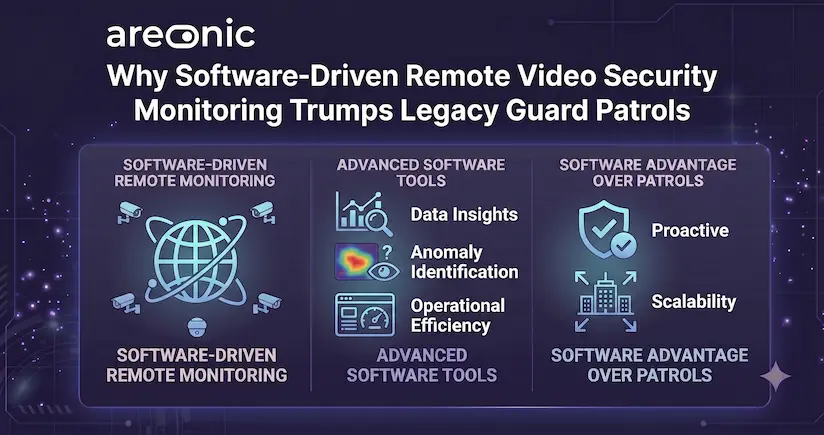
Why Software-Driven Remote Video Security Monitoring Trumps Legacy Guard Patrols
Multi-location franchise operations have outgrown the guard patrol and surveillance systems that used to secure them. A modern QSR or retail franchise runs access control, inventory management, and point-of-sale as networked services, yet security video too often sits apart from all of them, recording to an NVR no one watches until something has already gone wrong. Manual guard patrols cannot keep pace with that operational surface across 50 to 100 properties, and siloed surveillance footage produces archives without producing awareness. The shift underway turns the isolated video recorder into a remote video surveillance system that treats every camera as a live sensor feeding the franchise’s operational decision-making, rather than an archive consulted only in hindsight.
The Role of a Remote Video Surveillance System in Franchise Operations
A remote video surveillance system in a franchise network is a networked video tier that ingests camera streams, runs computer vision on them, and feeds the resulting telemetry into real-time operational workflows. It is no longer a standalone recorder used to review footage after an incident, but an active data source that security operations and facility management act on as events happen.
That reclassification changes where video sits in the operational architecture. Instead of terminating at a local NVR, streams terminate at an analytics tier that produces structured events, and those events become inputs to alert workflows, access control systems, and investigative databases. A confirmed unauthorized entry can trigger immediate notification and lock protocols, a cash-handling anomaly can flag for manual review, and a perimeter breach can activate deterrents, all without a security operator interpreting a video feed first. In this model the surveillance layer is less a security silo than a shared sensing capability the whole franchise network draws on.
Placement of the compute matters as much as the software. An edge-processing architecture runs inference on local servers at each location rather than shipping footage to a distant cloud, which keeps latency low enough for real-time alerting and keeps sensitive video inside your own network. That locality is what makes multi-site verification practical at scale: dozens of cameras across multiple properties can be correlated on site, in the moment, without the round-trip delay or bandwidth cost of centralizing raw data first.
Technical Architecture: Automated Threat Detection Meets Multi-Site Operations
The value of that networked architecture shows up in daily operations, where automated video processing does work that manual guard tours and periodic security reviews never could at scale. Three functions carry most of the operational return.
- Automated perimeter and entry point monitoring: Deep learning pipelines watch store entrances, service doors, loading docks, and parking areas continuously across all properties, flagging unauthorized intrusions and security events the moment they appear rather than on later review. Detection becomes a live signal instead of a forensic one. For regional franchises with 80 properties, this means every location receives constant algorithmic surveillance regardless of shift coverage or time of day.
- Unified sensor fusion and false alarm suppression: Vision analytics are cross-referenced against access-control readers, door sensors, and motion logs, so the system confirms genuine security threats and discards the environmental noise that generates most false alarms. Correlating multiple signals is what allows roughly 95 percent of that noise to be filtered before it escalates to personnel. Environmental triggers like shadows, weather changes, or passing vehicles generate thousands of alerts monthly in standard motion-triggered systems. Areonic’s multi-sensor correlation eliminates false alarm fatigue at the operations center level.
- Intelligent forensic search and investigation: Security teams execute deep multi-location investigations via natural language queries, indexing recorded metadata to identify specific event profiles in under two seconds. This replaces hour-long manual video review cycles. A security incident at one property can be correlated against patterns across the entire franchise portfolio instantly. Investigators ask the system “Show me all unauthorized entries at service doors between 2 AM and 4 AM across all Northeast locations in the past 30 days” and receive indexed results in milliseconds.
Areonic versus Legacy Surveillance Providers: Overcoming Infrastructure Lock-In
Legacy security providers make a quiet assumption: that a franchise will standardize on their equipment and remain dependent on their monitoring centers. Multi-location operations rarely can. Call-center-based surveillance systems from providers like Securitas and Everon route all video streams back to centralized human verification facilities, which introduces multi-minute response latency into every security event. Areonic works instead as a camera-agnostic software layer over standard ONVIF and RTSP, so facility operators integrate existing mixed IP camera fleets into an automated defense grid without having to migrate nvr dvr to cloud security solutions from scratch.
The more consequential lock-in is not the camera; it is the data and response model. Legacy security systems operate as isolated islands that keep video and alerts away from the workflows that could use them. Guard patrols remain the primary response mechanism because the surveillance system cannot verify its own alerts or trigger automated actions. Areonic exposes RESTful APIs and webhooks, so a verified security event immediately drives workflows elsewhere in the franchise network: incident alerts to store managers, automatic door locks at entry points, or emergency notification arrays. Security stops being a dead end and becomes a trigger the rest of the franchise responds to.
Architecture also decides the network bill. Streaming continuous raw video across the internet to remote monitoring centers saturates wide-area network links and scales badly across a franchise portfolio. A single 4K camera consumes 3 to 5 Mbps. For an 80-property franchise with 8 to 12 cameras per location, continuous cloud-based surveillance requires 960 to 1440 Mbps of aggregate bandwidth. Areonic runs machine learning locally at each location and keeps full-resolution archives on local storage, sending only event logs typically under 1 percent of network bandwidth up to the central multi-site dashboard. Full forensic detail stays on site; only intelligence travels the WAN.
Maximizing Security ROI and Operational Capital Efficiencies
The strongest financial argument for this architecture is what it does to the labor line. Fragmented legacy setups lean on physical guard patrols to compensate for systems that cannot verify their own alerts, and guard hours are the least scalable cost in a growing franchise portfolio. Automated, sensor-fused verification shifts that burden onto software, so a security team supervises confirmed exceptions instead of staffing continuous watch at each location, and the same headcount covers exponentially more properties as the franchise expands.
The cost model changes shape as well as size. A software-driven, cloud-native platform scales through licensing that tracks franchise growth predictably, rather than through step-function capital outlays for appliances and per-location hardware each time a new store opens. Local processing further trims the recurring cloud-transport spend that off-site surveillance models accumulate month after month.
For a franchise operator costing a multi-year expansion roadmap, the result is a total cost of ownership that bends downward as the footprint grows. Verification labor flattens, hardware refresh cycles shrink, and expansion becomes a configuration and licensing exercise instead of a capital equipment procurement.
Concretely, the migration reworks four cost centers that legacy surveillance treats as fixed:
- Guard patrol hours: Automated threat verification converts continuous manned watch into exception-based supervision, the single largest lever on security operations expense. A regional franchise maintaining 80 to 100 properties can eliminate perpetual hiring cycles and wage escalation costs tied to round-the-clock guard staffing.
- Appliance capital: An open software layer runs on existing cameras and standard servers, so each new location avoids a proprietary surveillance appliance purchase. When hardware reaches end-of-life, franchises replace it with current-generation commodity equipment without introducing new vendor dependencies.
- Cloud transport: Local inference keeps raw video off the WAN, replacing metered off-site streaming with lightweight event logs. Organizations recover 40 to 60 percent of previously allocated WAN bandwidth, which flows back to supporting business applications and reducing monthly circuit costs.
- Investigative labor: Forensic search acceleration replaces hour-long manual review with millisecond indexed queries, freeing security analysts from reactive video triage and enabling strategic threat assessment.
Conclusion
A franchise network is only as secure as the verification speed and accuracy of its distributed security systems. Video is the richest sensing layer most multi-location operations already own. Reframing surveillance from isolated recorders into a remote video surveillance system an analytics tier feeding operational workflows rather than an archive consulted after incidents is what lets a franchise verify threats in real time, suppress false alarms at the source, and make evidence-based security decisions across 50 or 100 properties simultaneously. Areonic delivers that as open, camera-agnostic software that keeps sensitive video local, integrates through standard APIs, and scales its cost with franchise growth instead of ahead of it. Teams planning a multi-location security deployment can request an architecture briefing to map the platform onto their existing cameras, access control, and operational systems.
Frequently Asked Questions (FAQ)