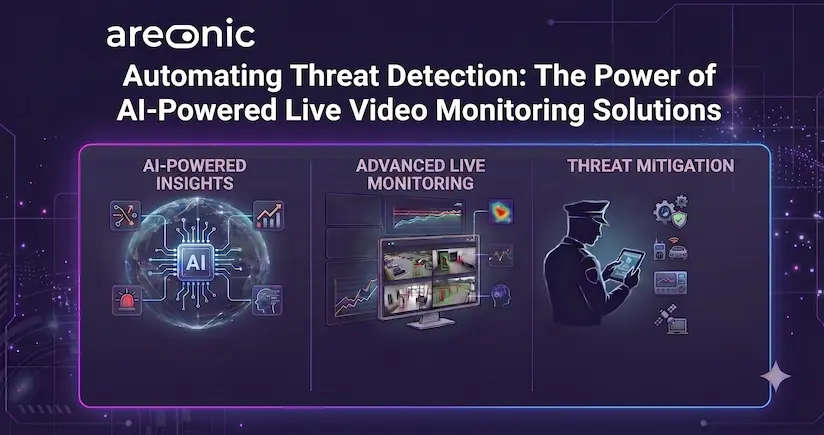
Automating Threat Detection: The Power of AI-Powered Live Video Monitoring Solutions
Security teams today face an impossible math: too many cameras, too many false alarms, and not enough people to watch them all. Traditional surveillance systems sit quietly recording footage that nobody looks at until something’s already gone wrong. The real cost isn’t in the cameras it’s in the people you need staffed around the clock to review alerts that are mostly noise.
Live video monitoring solutions change that equation entirely. By automating threat detection at the edge of your network instead of routing everything to a centralized call center, you get immediate response milliseconds instead of minutes. The benefit compounds fast: 95% fewer false alarms, 90% less bandwidth chewing up your WAN circuits, and genuine security events verified before they escalate into actual incidents.
The Shift to Automated Threat Detection in Enterprise Security
Here’s the fundamental difference: traditional surveillance streams everything to a remote call center where an operator watches it happen, makes a judgment call, then calls you. That’s slow by design.
Live video monitoring solutions flip the script. They process threat signals right where the cameras are on your network, not somebody else’s cloud. Computer vision models run locally, make decisions in real time, and activate your deterrents (lights, access denial, alerts) before a distant operator even knows an event happened.
The advantage becomes obvious at scale: you can monitor thousands of camera feeds simultaneously without running into human fatigue, shift gaps, or operator distraction. The system tracks who’s crossing perimeter lines, how long they’re staying in restricted zones, and correlates that against your access logs and door sensors. It filters out the noise shadows, weather changes, passing vehicles and only alerts you on actual threats. It works the same way at 3 AM as it does at 3 PM.
The reason this works is that the AI lives on your infrastructure, not in some cloud provider’s data center thousands of miles away. You’re not waiting for data to travel to the cloud, wait in a queue, get processed, travel back, and then finally get acted on. That round trip alone network latency plus cloud processing queues eats up a minute or more.
With edge inference, everything happens locally, in tens of milliseconds. The camera detects a threat, the system verifies it, and your deterrents activate before most people could even react. Traditional monitored systems? 30 to 60 seconds minimum, every time.
Core Engineering Capabilities of AI-Powered Live Video Monitoring
The real engineering here comes down to three things working together.
Intelligent Sensor Fusion: Raw motion detection is garbage shadows, weather, a passing car, and you get thousands of false alerts monthly. Your team spends all night chasing ghosts. The smart part is combining video with everything else: door sensors, access logs, configured security zones.
Example: Camera sees movement at the loading dock at 2 AM. That’s a possible breach. But did an access card get used? Does someone have authorization to be there? Is the door sensor showing it’s actually open? The system cross-references all of it instantly. If the camera detected something but all the other signals say it’s normal, it’s probably just an animal or tree branch. If the camera detected something AND the door opened without authorization AND nobody should be there, that’s a real threat. This multi-layer approach kills 95% of false positives before they ever reach your team.
Sub-Second Forensic Search: When something happens, you need answers fast. Manually scrubbing through video to figure out what occurred and when takes hours. Instead, you ask the system: “Show me all unauthorized entries at Loading Dock A between 2 AM and 4 AM in the past 30 days.” It gives you results in milliseconds. You see the exact moment someone shouldn’t have been there, correlate it across your entire facility network, and spot patterns that would take a person days to find.
Smart Bandwidth Usage: Streaming full 4K video from every camera to the cloud all day is a bandwidth nightmare and expensive. The system is smarter. It sends lightweight metadata during normal operations (“camera 3 detected a person, 8:42 AM, confidence 87%”). If something actually looks like a threat, it grabs the full-resolution footage for evidence. You get forensic detail when it matters, without drowning your WAN links.
Areonic versus Everon Solutions: Architectural Confrontation
Here’s where the architecture matters most. Everon Solutions built their business on human operators reviewing alerts in a centralized call center. That means every security event takes however long it takes for your alert to get there, wait in queue, get reviewed, decided on, and escalated. Minutes, every single time. Areonic takes a completely different approach.
The Speed Problem
With Everon, everything goes to their monitoring station. Your alert enters a queue. Waits for an operator. Gets reviewed. Gets judged. Then escalates. That’s minutes. A breach at your Midwest facility at 2 AM has to travel all that way and wait all that time.
With Areonic, the threat verification happens on your network in milliseconds. Deterrents activate instantly. The difference between containing a threat at the moment it happens versus after someone’s reviewed it? That’s everything for high-security assets or time-critical situations.
No Hardware Lock-In
Everon requires you to buy their proprietary appliances. That means monthly leases, integration nightmares with your existing IT, and a capital hit every time you add a facility to the portfolio.
Areonic is just software. It runs on the servers you already have commodity hardware, private cloud, virtualized environments, doesn’t matter. You don’t buy anything. When your servers need replacing in five years, you just replace them with whatever’s current then. No vendor lock-in, no recurring appliance costs.
The Bandwidth Math
One 4K camera streaming continuously to the cloud takes 3 to 5 Mbps of your WAN. Multiply that by 50 to 100 locations and you’re looking at thousands of dollars a month in data costs. It’s economically broken at any real scale.
Areonic keeps video local and sends only metadata upstream less than 1% of your bandwidth. You get 40 to 60% of your WAN budget back. Those circuit costs drop. And your video stays on your network, not floating through the public internet on its way to somebody else’s data center.
Zero-Trust Infrastructure Architecture and Compliance
Enterprise IT has requirements. Data protection standards, security protocols, compliance frameworks. Areonic was built with that in mind from day one.
Works With What You Have: You’ve probably got cameras from three different vendors. Areonic works with all of them over standard ONVIF and RTSP protocols, eliminating the need to deploy specialized cloud based surveillance cameras across the entire estate. No rip-and-replace. No vendor lock-in. Just plug in to your existing network.
Security Built In: Complete encryption end-to-end (TLS in flight, AES-256 at rest). Multi-factor authentication. Role-based access control. Your video stays encrypted from the camera to your infrastructure nobody in between can intercept it. Admin access requires hardware tokens. Every investigative query gets logged for audit. It supports SOC 2 Type II and aligns with zero-trust principles.
Technical Product FAQ