Enterprise Security Architecture: Integrating Alarms, Access Control, and Video Surveillance
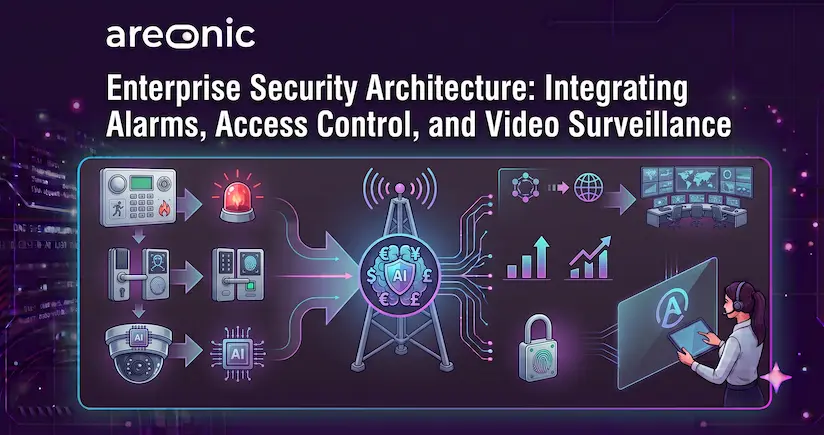
Fragmented enterprise security fails in predictable ways: alarms, badges, and cameras each write to their own database, their timestamps drift apart, and an operator has to context-switch across three consoles to reconstruct a single event. By the time the access log and the video are lined up by hand, the incident is over. The fix is architectural rather than additive, a Common Operating Platform that ingests every input as one correlated stream. This guide covers the three pillars of that architecture, the Sensor Fusion that binds them, and why integrated access control solutions, alarms, and enterprise video belong on one software core instead of being stitched together with proprietary middleware. Done properly, access control security solutions stop being a silo and become one input among many.
The Three Pillars of Enterprise Security: Alarms, Access Control Security Solutions, and Surveillance
Access control security solutions are the hardware and software that authenticate identity and authorize entry to a facility, spanning encrypted door controllers, credential readers, and the identity governance that decides who may go where. In a converged enterprise architecture they form one of three pillars, integrated with intrusion alarms and video surveillance so that every access event arrives with context instead of standing alone in its own database.
A converged architecture is built from three engineering tiers, each producing a different kind of signal that becomes intelligence only when fused with the others.
- Intrusion alarm and perimeter layer: Physical barrier sensors, radar and thermal tripwires, and dry-contact relays transmit raw binary alarm state, open or closed, tripped or clear. On its own this layer knows something happened but nothing about what or who.
- Access control and identity governance layer: Smart door controllers running encrypted OSDP v2 lines manage employee credentials and synchronize with enterprise identity providers such as Microsoft Entra ID and Okta over SCIM, so the access layer always mirrors the current directory. These are the access control security solutions from which the other two pillars borrow identity.
- Enterprise surveillance system layer: High-throughput IP camera networks stream standard ONVIF (Profile S, T, and M) and RTSP feeds to localized processing nodes, carrying the visual truth the alarm and access layers lack. Deploying robust Enterprise cloud security cameras provides the visual ground truth that alarm and access layers lack, determining what actually happened once another signal pinpoints when.
Read in isolation, each pillar is nearly useless for triage: an alarm relay reports a state change with no cause, an access log names an identity with no scene, and a camera shows a scene with no identity or trigger. Convergence is valuable precisely because the pillars answer different questions, and only their intersection produces a complete event. The engineering challenge, and the subject of the next section, is joining three signal formats that were never designed to speak to one another.
Sensor Fusion: Bridging Data Silos into Actionable Intelligence
Fusing three signal types into one event is a specific engineering problem, not a dashboard that shows three feeds side by side. Three mechanisms make real-time event correlation across integrated access control solutions, alarms, and cameras reliable.
- Real-time timestamp synchronization: Disparate hardware nodes drift, so the platform normalizes their clocks with Precision Time Protocol (PTP) and NTP, aligning an access log entry with the exact camera frame that shows it down to the millisecond. Without that alignment, correlation is guesswork.
- Automated threat verification and false alarm suppression: A passive motion trigger is cross-referenced against real-time computer vision object classification and the badge authorization log before it is escalated, which is how roughly 95 percent of operational false alarms are removed. An alarm confirmed by all three sources is a real event; one contradicted by them is noise.
- Automated cross-system response rules: Correlation drives action, not just display. A verified perimeter breach can programmatically pivot nearby PTZ cameras onto the location, lock down the corresponding access zones, and push a high-priority visual alert to mobile field teams, all without an operator issuing a command.
Areonic vs. Legacy PSIM Frameworks: The Software-Driven Advantage
A PSIM was the industry’s first answer to fragmentation, and it solved the problem by adding a layer rather than removing one. That single design decision explains most of the gap between a legacy stack and what Areonic does.
That extra layer is heavy by design. Traditional PSIM platforms and proprietary enterprise suites require substantial on-premise server blocks, database clustering, and the staff to maintain them, because the integration logic lives in a central tier bolted above the systems it connects. Areonic runs as microservices that process video metadata and telemetry locally on commodity hardware, so correlation happens at the edge instead of in a server room built to host middleware.
It is also closed by default. Legacy convergence typically requires the vendor’s own access boards and cameras, which turns integration into procurement. Areonic is hardware-agnostic: it connects to any standard access system through RESTful API orchestration and ingests any existing enterprise camera system over open ONVIF profiles, so the estate already in place becomes the integration rather than an obstacle to it.
And it leaves the data in two places. On a PSIM, reconstructing an incident still means cross-referencing a separate door-log database against a separate video timeline by hand. Areonic indexes access events directly into video metadata, so an operator queries a plain-language event, for example “door forced open at the north gate during off-hours,” and reviews the verified clip in under two seconds, from one index rather than two systems.
Network Architecture, Cyber Hardening, and Infrastructure TCO
The same edge-first design that speeds correlation also governs the network and security posture. Because computer vision runs on local nodes and only correlated event metadata crosses the WAN, an integrated platform consumes under one percent of the bandwidth a cloud-upload model would, keeping multi-site links clear and full-resolution video on local storage where it belongs.
Cyber hardening follows the same architecture. End-to-end encryption, TLS in transit and AES-256 at rest, protects every stream and log, and because the platform fits a zero-trust network architecture with role-based access and outbound-only connections, converging the pillars does not widen the attack surface. Unifying physical and cyber telemetry actually narrows it, since anomalies become visible across systems rather than hidden inside one.
The financial case is the sum of these effects. Replacing heavyweight PSIM servers and per-channel licensing with a microservice platform on existing hardware collapses both CapEx and maintenance OpEx, and a predictable software license that scales across sites turns security expansion into a line item rather than a project. For an architect costing a multi-site rollout, that predictability is usually the deciding factor.
Conclusion
Enterprise security stops failing at the seams when alarms, access, and video stop being three systems and become one correlated stream. The architecture that achieves it is a Common Operating Platform: three signal pillars, a fusion engine that aligns them to the millisecond and verifies events across all three, and response rules that act without waiting on an operator. Areonic delivers that as a lightweight, hardware-agnostic software core that runs at the edge, unifies existing access control security solutions, alarms, and cameras, and replaces the heavyweight PSIM middleware that made convergence expensive in the first place. Architects designing a unified ecosystem can request a technical architecture briefing to map the platform onto their existing controllers, panels, and camera fleet.