The AI Operations Assistant in Retail: Shrinkage Mitigation, Shelf Intelligence, and Floor Defense
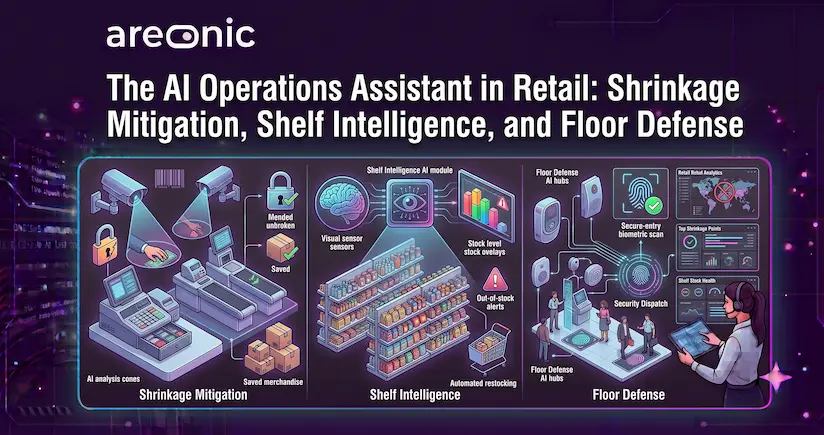
Retail is caught between two costs that pull against each other. Shrinkage, driven increasingly by organized retail crime, keeps climbing, while the standard response, locking merchandise behind glass and cable, drives honest shoppers away and measurably cuts conversion. Locking the store down to stop theft trades one loss for another. The way out is to make the cameras already overhead do the watching: an AI operations assistant that runs computer vision on standard feeds, detects theft behavior as it forms, and alerts a floor associate in seconds, without turning the sales floor into a vault. This guide covers why physical deterrents hit a ceiling, how edge video AI replaces the lockbox model, and how one camera layer serves both loss prevention and merchandising.
The Architectural Limits of Traditional Store Theft Deterrence Solutions
Store theft deterrence solutions are the combined physical fixtures, electronic alarms, and monitoring practices a retailer uses to discourage and detect theft. Their traditional forms are passive and reactive, deterring the opportunist while doing nothing to give staff advance warning, which is exactly where they run out of room.
Three limits define the legacy model.
- Passive physical barriers: Glass lockboxes, cable tethers, and spider wraps deter casual shoplifters but frustrate legitimate shoppers, and locked merchandise can cut conversion on affected SKUs by as much as 25 percent. Every lock is a sale made harder in order to make a theft harder.
- Isolated EAS pedestals: Doorway gates alarm only after an item has already crossed the exit, giving loss prevention no prior context and no chance to intervene before the threshold, while nuisance alarms erode staff and customer trust in the system.
- Human monitoring constraints: A small store team cannot simultaneously run checkout, help customers, and watch dozens of CCTV feeds across the floor’s blind spots, so the footage exists but no one is actually watching it in the moment that matters.
The common thread is timing: every legacy control acts at or after the moment of loss, never before it. A lock reacts to a hand already at the shelf, a pedestal reacts to an item already at the door, and a recorder is reviewed only after the theft is discovered. Computer vision shrinkage detection moves the intervention earlier, reading the behavior that precedes theft, which is the one thing physical fixtures structurally cannot do. That shift from reaction to anticipation is what an AI store assistant adds on top of the deterrents already in place.
Evaluating Modern Retail Security Devices: Physical Fixtures vs. Visual Edge AI
Modern retail security devices split into two philosophies: physical fixtures that restrict access to merchandise, and visual edge AI that watches behavior around open merchandise. The first stops the hand at the shelf; the second understands what the hand is doing, and the difference decides both loss and experience.
- Mechanical display protection: Smart keys, lockable peg hooks, and sensor stands require an associate to physically intervene for every customer interaction, which protects the item but converts each purchase into a staffed, friction-heavy transaction. The security is real and so is the drag on sales.
- Point-of-sale (POS) integration nodes: Overhead optical sensors synchronized with the checkout scanner cross-verify scanned items against the physical basket, flagging non-scans and sweethearting the instant they happen. This is deterrence at the register rather than at the shelf, aimed at the internal and collusive theft locks cannot touch.
- Dynamic shelf intelligence sensors: Overhead computer vision monitors replenishment levels and detects rapid shelf-sweeping, the bulk grab of high-value SKUs, as it occurs. The same sensor that flags a sweep also tells merchandising when a shelf is empty, which no lockbox has ever done.
The Dual-Role AI Assistant: Unifying Loss Prevention and Store Merchandising
The reason to run this as software rather than a single-purpose alarm is that one video stream answers both security and operations questions at once. Three capabilities carry that dual value.
- Behavioral concealment and ORC detection: Neural networks analyze spatial movement and skeletal vectors to flag unnatural actions, shoving multiple items into a lined booster bag, or loitering near an emergency exit, before the theft is completed rather than after. Reading the behavior is what turns surveillance from a record into a warning.
- Automated shelf out-of-stock alerts: Computer vision watches shelf gap density and notifies inventory staff the moment a high-velocity display runs dry, so lost sales from an empty shelf are caught in minutes instead of at the next manual walk. The security camera becomes a revenue instrument, since an out-of-stock on a fast-moving SKU is a silent, recurring loss that no theft deterrent would ever surface.
- Checkout queue and dwell tracking: Measuring line density and dwell time across departments lets the system dispatch associates to open registers before customers abandon full baskets, converting a security feed into a live staffing signal.
What makes these run together rather than as three separate products is a shared pipeline. Edge-inference processing turns each camera frame into structured events on site, POS video sync ties register data to the matching footage, and the same event stream drives real-time associate notifications to the floor. Loss prevention, merchandising, and staffing all read from one layer, which is why the assistant pays back against several budgets at once rather than only the retail security line.
The Areonic Advantage: Pure Software Over Dedicated Hardware Silos
Dedicated retail AI ships as its own hardware silo, a smart camera or an edge box bought per store, which is the very model that makes it expensive and slow to roll out. Areonic runs the intelligence as software on the cameras a store already has, and the advantage separates into three parts.
Existing cameras are the first. Proprietary retail AI platforms force a chain to buy specialized smart cameras or costly edge appliances for every location. Areonic runs as a software layer on standard enterprise servers and ingests from any pre-existing ONVIF-compliant IP camera, so the overhead camera already covering an aisle becomes the analytics sensor.
Bandwidth is the second, and in a store it is unforgiving. Streaming continuous in-store video to a cloud AI provider chokes the same Wi-Fi and POS network the business runs on. Areonic executes deep learning locally at the store edge, keeps high-resolution video on site, and uses under one percent of network bandwidth for central management, so analytics never compete with the registers.
Retrieval across a chain is the third. Rather than scrubbing hours of multi-camera footage per store, a director runs a plain-language query such as “bulk cosmetics taken after 7 PM” and Areonic returns the verified clip across every branch in under two seconds. Investigation that once took an afternoon becomes a search box.
Conclusion
The lockbox model of retail security is hitting its limit: it stops some theft while quietly taxing every honest sale, and it gives staff no warning before an incident. An AI operations assistant changes the trade by watching behavior on the cameras already installed, catching concealment and sweethearting as they form, flagging empty shelves, and routing staff to queues, all from one feed. Areonic delivers that as camera-agnostic software that keeps video local, holds WAN load under one percent, and answers cross-store questions in seconds, without a hardware silo or a locked-down sales floor. Loss prevention and store operations leaders can request a technical architecture briefing to map the assistant onto their existing cameras and POS.