Complete Guide to Warehouse & Logistics Security: Camera Placement and Coverage Strategies
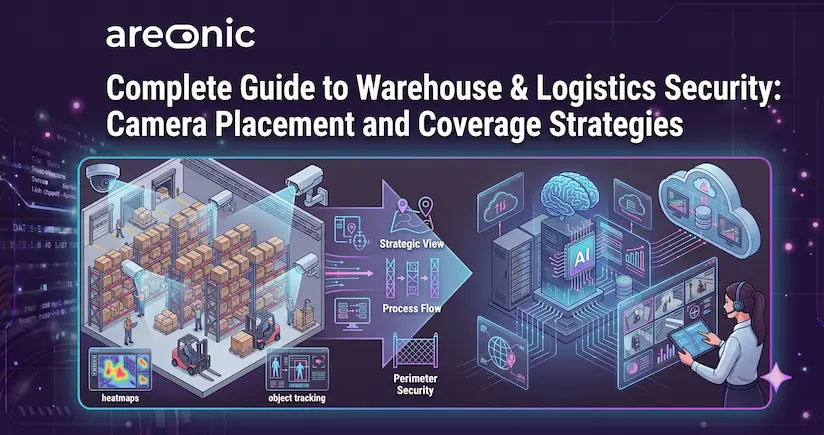
Warehouse security fails in the geometry, not the gear. Cavernous vertical racking creates canyons that ordinary cameras cannot see into, heavy machinery throws moving blind spots across the floor, high inventory turnover multiplies the moments when goods change hands unwatched, and internal shrinkage hides inside all of it. Bolting up warehouse security cameras wherever a mount is convenient produces footage without coverage. A distribution center instead needs a mathematically planned framework where sensor choice, focal length, mounting height, and lighting are matched to each physical zone. This guide maps that framework across the four zones that define a logistics facility and the hardware and software that make it work.
The Strategic Zones of Warehouse Video Surveillance
Warehouse video surveillance is the deployment of cameras and analytics engineered around a facility’s physical geometry, its docks, aisles, storage cages, and yard, rather than as uniform blanket coverage. Because a distribution center’s risk concentrates at specific choke points and blind spots, effective coverage is a placement problem solved with sensor selection and geometry, not a matter of simply adding more cameras.
General area coverage wastes resolution on empty floor while leaving the high-value moments underwatched, which is why warehouse security cameras have to be positioned by zone rather than by convenience. The four zones below each carry a distinct threat profile and therefore a distinct optical answer.
Loading Docks and Bay Doors (High-Risk Ingress/Egress)
Docks are the building’s highest-risk boundary, where custody of goods changes hands and most external theft and paperwork fraud begin. Coverage here has two jobs: document every cargo handoff against the bill of lading and record the trailer interior as it is loaded or emptied. The lighting is punishing, since an open bay door places bright daylight directly behind a dark interior, so the fixed dome or bullet cameras mounted inside facing outward must run high dynamic range to hold detail across that gradient.A second external varifocal camera frames each trailer plate for a license plate recognition system, which anchors loading dock security to a verifiable vehicle record.
High-Bay Racking and Narrow Aisles
Vertical racking creates the facility’s worst blind spots: a 30-foot shelf run is a canyon a wide-angle lens cannot see down. The optical answer is corridor mode, a rotated 9:16 aspect ratio that maps the sensor onto the long, narrow aisle instead of spending half its pixels on shelf faces. Pairing that with a narrow focal length in the 6 to 12 mm range extends depth of field down the corridor, giving usable detail on forklift movement and personnel along the full aisle. Blind spot elimination here is a geometry problem before it is a camera-count problem, which is exactly what narrow aisle optical coverage is designed to solve.
Packing Stations and High-Value Cage Storage
Where docks face outward threats, packing and cage areas face internal ones: shrinkage, return fraud, and disputes over what was actually packed. These stations need forensic resolution rather than wide coverage, so 4K or 8MP wide-angle sensors mounted directly overhead are the right choice, close enough to resolve a barcode, a serial number, and individual hand movements at the bench. Overhead placement also removes the body-blocking angles that let sleight-of-hand go unrecorded. For inventory shrinkage prevention, clarity at the point of handling matters far more than square footage.
Perimeter Fencing and Logistics Yards
The yard is wide, dark, and sparsely mounted, which rules out conventional cameras on their own. Long-range thermal sensors detect human heat signatures across unlit staging areas where visible-light cameras register nothing, while multi-sensor 180 or 360 degree panoramic units cover broad acreage from a single pole and cut the number of mounting posts and cable runs. The choice between a steerable PTZ and a fixed multi-sensor array matters most here: a PTZ tracks one target well but misses everything else while it is turned, whereas a multi-sensor records the entire scene continuously. Gate lines then add LPR to log every vehicle entering the staging area.
Selecting the Best Security Camera System for Warehouse Deployments
Zone placement decides where cameras go; the hardware specification decides whether they perform once mounted. For enterprise IT teams weighing the best security camera system for warehouse deployments, four parameters carry the most operational weight when specifying warehouse security cameras.
- Optical flexibility and corridor mode: The ability to reshape the aspect ratio to a long, narrow aisle so the sensor is not spending half its resolution on shelf edges. Fixed-ratio cameras waste pixels; adjustable optics put them where the risk actually is.
- Environmental ingress and vandal ratings: Outdoor and cold-storage units need IP66 or IP67 sealing against dust, washdown, and temperature swings, plus IK10 impact resistance to survive forklift contact and flying debris. Environmental ingress protection is not optional inside an industrial envelope.
- Power over Ethernet (PoE) topology: PoE and PoE+ switches (IEEE 802.3at) carry power, video, and telemetry over a single Cat6 run, removing the need for separate electrical drops across a sprawling floor plate and making expansion a cabling exercise rather than an electrical project.
- Thermal and low-light performance: Advanced low-light sensors such as Sony STARVIS, together with true thermal optics for unlit container yards, keep exterior coverage usable after dark without flooding the site with additional lighting.
Areonic vs. Legacy Hardware Bundles: The Software-Driven Advantage
Hardware bundles and the basic kits reviewed on consumer and SMB blogs answer the wrong question first: which cameras must you standardize on? Areonic starts from the opposite premise, treating cameras as interchangeable inputs and placing the intelligence in software.
A hardware bundle forces logistics operators to buy identical, branded cameras, which inflates deployment CapEx and strands any existing fleet that does not match. Areonic runs as a camera-agnostic layer, so a facility can combine thermal units, 4K dock cameras, and legacy ONVIF streams under one dashboard and select the right optic for each zone rather than one brand for all of them.
The scale of a distribution center then breaks the cloud-upload model outright. Streaming hundreds of high-resolution feeds continuously to an off-site cloud congests the WAN and makes remote yards unworkable. Areonic executes computer vision and edge video analytics on local servers, keeping full-resolution archives on site while routing under one percent of bandwidth, metadata only, to the management dashboard.
When a pallet goes missing, the clock is the cost. Legacy systems leave staff dragging timeline sliders for hours to find a single event. Areonic indexes metadata for natural language search, so a manager types a query such as “forklift near Bay 4 after 10 PM” and retrieves the verified clip in under two seconds.
Operational ROI: Transforming Security into Operational Intelligence
The financial case for a modern warehouse camera system reaches well past theft mitigation, because the feeds that secure the building also measure how it runs. Applying computer vision to existing cameras converts surveillance into operational telemetry at no additional hardware cost.
The same analytics that flag an intrusion also flag a forklift bottleneck at a cross-dock, a congested pick path, or a worker entering a hazard zone without a high-visibility vest or hard hat. That shifts safety and throughput from periodic audits to continuous measurement, and PPE compliance in particular becomes an automatic, logged signal rather than a spot check.
Freight claims are the clearest dollar return. When a carrier disputes damage or a short shipment, timestamped video of the exact load event settles the matter from the record instead of through negotiation, frequently recovering more in a year than the platform costs. Loss prevention, safety, and claims defense then run on a single video layer instead of three separate systems.
Conclusion
Effective warehouse security is a design discipline rather than a purchase. Coverage follows the building’s geometry, docks, aisles, cages, and yard, each demanding a specific optic, mounting height, and lighting strategy, and the hardware specification has to match an industrial envelope of dust, impact, and darkness. Areonic sits above all of it as a camera-agnostic software layer that unifies whatever cameras each zone requires, keeps heavy video and analytics local, and turns the footage into loss-prevention, safety, and operational intelligence in real time. Teams planning or upgrading a facility can request a technical architecture briefing to map camera placement and coverage against their actual floor plan.
Frequently Asked Questions (FAQ)