Enterprise Cloud Video Security: Modern Surveillance Architecture for Multi-Site Scale
Surveillance that works in one building routinely collapses across fifty. Scaling it turns manageable problems into structural ones: each region ends up with its own siloed servers, remote access leans on brittle site-to-site VPNs, continuous video pushes WAN demand past what the links were sized for, and an investigation that spans locations means scrubbing separate timelines by hand. Enterprise video security only becomes coherent when the architecture is designed for the multi-site case from the start, distributing compute to the edge while centralizing oversight in the cloud. This guide lays out that architecture, the tiers it runs on, and why edge-computed enterprise surveillance outperforms the legacy recorder model at scale.
The Structural Blueprint of Modern Enterprise Surveillance
Enterprise surveillance is video security engineered to operate across many facilities as one system rather than as a collection of independent site recorders, with centralized management, consistent policy, and cross-site search. At scale its defining problem is not the camera but the network between sites: how to analyze, store, and retrieve video across a distributed footprint without saturating the WAN or fragmenting oversight.
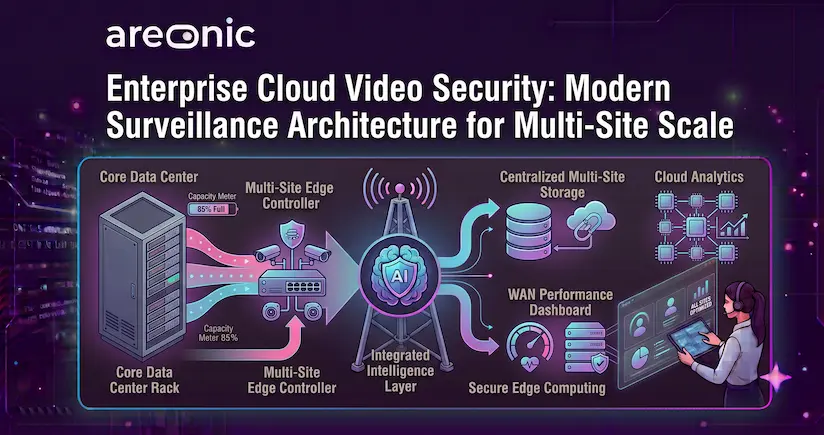
A modern deployment is built from three tiers, each solving a distinct part of the scale problem. Their separation is the point, since decoupling compute, management, and ingestion lets each one scale on its own terms.
- The distributed edge compute tier: Localized microservice inference runs on commodity enterprise servers or virtualized clusters at each site, executing neural networks directly adjacent to the camera feeds. Keeping inference next to the cameras eliminates the off-site round trip that adds latency and bandwidth in centralized designs.
- The centralized multi-tenant cloud tier: A single cloud plane provides global administration, aggregated access management, SSO, and unified policy across hundreds of facilities, without a dedicated site-to-site VPN per location. A multi-tenant cloud VMS is what lets one team govern the whole estate from one console while each site keeps running independently.
- The camera-agnostic ingestion tier: Streams are ingested over open standards, ONVIF Profile S, G, T, and M and RTSP, so an organization retains whatever camera fleets it already owns across regions. Camera-agnostic integration is what turns a mixed, acquired-over-time estate into one system instead of a dozen incompatible ones.
The value of the blueprint is in how the tiers interact rather than in any one of them. Edge-to-cloud computing lets the heavy work stay local while the light work stays central: inference and storage sit at the site, governance and search sit in the cloud, and only metadata crosses between them. That division is what allows a deployment to add its hundredth site without adding a hundredth management burden, because scale accrues to the edge tier while the cloud tier stays a single, consistent control plane.
Eliminating the WAN Bottleneck in Enterprise Video Security
Hundreds of concurrent streams will crash an enterprise network the moment they are all pointed off-site. High-density stream management at scale depends on not moving the video in the first place.
- Local processing with cloud orchestration: Rather than uploading continuous 4K video across the WAN as pure-cloud models do, the platform runs inference and stores full-resolution archives on local network storage, sending only lightweight text metadata upward. The cloud orchestrates but does not ingest, which is the core of WAN bandwidth optimization.
- Dynamic adaptive bitrate ingestion: Stream bitrates and resolution tiers are tuned in real time to current network conditions, with high-bitrate pipelines reserved for verified security events rather than spent on empty corridors. Bandwidth follows importance instead of being consumed uniformly across every feed.
- Asynchronous alert transmission: Event triggers, motion parameters, and telemetry are structured as compact JSON payloads, so mobile alerts arrive instantly even at remote sites running on restricted cellular or satellite uplinks. A thin metadata channel keeps far-flung facilities as responsive as headquarters.
The Areonic Platform Advantage: Transforming Multi-Site Physical Defense
At a single site most enterprise platforms perform adequately; the failures show up between sites, where scale exposes the seams. Areonic is built for that multi-site reality, and its advantages are clearest exactly where legacy systems fragment.
A multi-site estate almost never standardizes on one camera brand. Regional buildouts, acquisitions, and staggered budgets leave a patchwork, and closed platforms, Lumana and single-brand NVR stacks among them, require their own gateway boxes or approved cameras to function. Areonic installs as a fully camera-agnostic software layer on existing commodity servers, providing seamless cloud video surveillance so the mixed fleet becomes one system with no rip-and-replace cycle.
Investigation is where the multi-site penalty compounds. A legacy deployment forces security teams to scrub separate timeline bars across each region’s NVR, one site at a time. Areonic indexes video metadata globally at the edge and drives automated threat triage from the same index, so an operator runs a single natural language query, for example “red logistics van near gate 3 after midnight,” and surfaces the matching clip across every site in under two seconds.
Every site added to a legacy deployment also adds attack surface, usually through the open inbound ports that remote viewing depends on. Areonic holds a strict zero-trust posture instead: outbound-only TLS 1.3 tunnels, AES-256 encryption at rest, role-based access control (RBAC) scoping every operator, automated firmware posture audits, and SOC 2 Type II compliance, so growing the footprint hardens the estate rather than widening its perimeter.
Maximizing Long-Term Scalability and Infrastructure TCO
The financial case scales with the footprint, because the costs a legacy model repeats at every site are exactly what the software model removes. Eliminating the NVR replacement cycle is the first of them: local commodity servers running software avoid the every-five-to-seven-year appliance refresh that dedicated recorders impose across every location.
Recurring fees are the second. Keeping video local avoids the per-camera cloud streaming and storage charges that, multiplied across hundreds of cameras and many sites, come to dominate a pure-cloud budget over a multi-year horizon.
Operational consolidation is the third and largest. A unified cloud plane lets several regional security operations collapse into one centralized SOC, so a single team supervises exceptions across the estate rather than staffing a booth per region. The saving compounds with every site added, because headcount tracks the number of real events, not the number of buildings. And faster incident resolution, verified video retrieved in seconds, directly mitigates corporate liability, which for a distributed enterprise is frequently the single largest avoided cost of all.
Conclusion
Enterprise surveillance stops fragmenting when it is architected for scale rather than assembled site by site. Distributing inference to the edge, centralizing management in a multi-tenant cloud, and ingesting any camera over open standards turns a dozen regional silos into one system that stays fast, private, and searchable across the whole footprint. Areonic delivers that architecture as camera-agnostic software on existing hardware, cutting WAN load to under one percent, hardening the estate under zero-trust, and consolidating regional operations into a single console. Security and IT leaders scaling across sites can request a technical architecture briefing to map the model onto their regions, cameras, and network.