
DVR vs. NVR: What is the Difference and Which is Better?
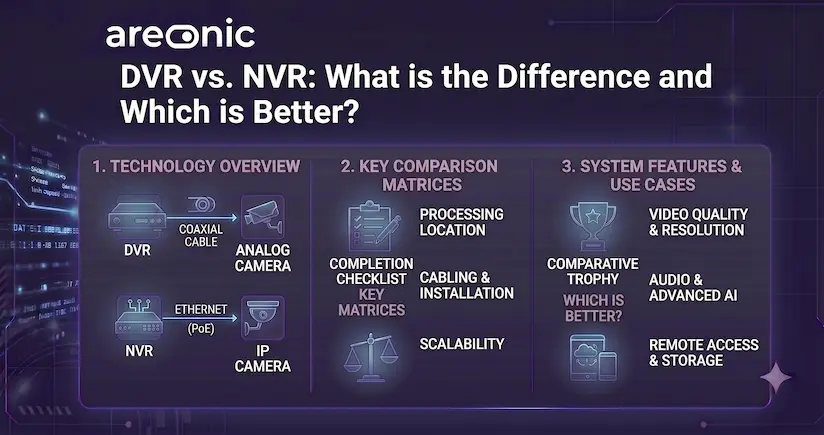
Most surveillance environments still run on one of two recorder architectures: DVR (digital video recorder) or NVR (network video recorder). The choice was straightforward a decade ago, when analog and IP camera systems barely overlapped, but hybrid installations, HD-over-coax standards, and cloud migration have blurred the lines. Understanding the actual technical differences – how each recorder handles video, what cameras it supports, where it hits limits – is now a prerequisite for any surveillance decision, whether you’re specifying a new install, expanding an existing site, or planning a migration to cloud video management. This guide covers both architectures, compares them across the criteria that matter, and outlines when each still makes sense.
What is a DVR?
A digital video recorder (DVR) records video from analog cameras connected via coaxial cabling (typically RG-59 or RG-6 with BNC connectors). The analog signal travels raw from camera to recorder; the DVR itself performs the digitization, compression, and storage. In short: the camera captures, the recorder does the work.
DVR systems are the traditional CCTV architecture. They dominated commercial surveillance for two decades and remain widely deployed today, particularly in retail, hospitality, and single-site operations where analog infrastructure was installed years ago and continues to function.
Modern DVRs frequently support HD-over-coax standards – HD-TVI, HD-CVI, and AHD – which transmit high-definition video (up to 4K in some cases) over the same coaxial cabling as legacy analog. This is what allows businesses to upgrade image quality without pulling new wire.
What is an NVR?
A network video recorder (NVR) records video from IP cameras connected over an ethernet network. Unlike a DVR, the NVR does not process raw video – each IP camera digitizes and encodes footage itself, then streams it as data to the recorder over the network.
The consequence: the NVR is fundamentally a storage-and-management appliance rather than a video-processing one. Because compression happens at the camera, image quality is not degraded by cable-length signal loss, and features like edge analytics, motion detection, and metadata can be handled directly on the camera.
NVR deployments typically use Power over Ethernet (PoE) so that a single Cat5e or Cat6 cable delivers both data and power to each camera, simplifying installation.
DVR vs. NVR: Head-to-Head Comparison
| DVR | NVR | |
|---|---|---|
| Camera type | Analog (or HD analog: TVI/CVI/AHD) | IP cameras |
| Cabling | Coaxial (BNC) | Ethernet (Cat5e/Cat6), PoE |
| Video processing | At the recorder | At the camera |
| Maximum resolution | Up to 4K on HD-analog standards | Up to 4K, 8K, and beyond |
| Audio support | Requires separate audio cabling | Transmitted over the same ethernet cable |
| Scalability | Fixed channel count (typically 4/8/16/32) | More flexible; scales with network capacity |
| Analytics | Limited; processed at recorder | Advanced edge analytics possible on the camera |
| Installation complexity | Simple point-to-point wiring | Requires proper network design (switches, PoE, VLANs) |
| Camera flexibility | Locked to one recorder | Cameras can be placed anywhere on the network |
| Cost profile | Lower upfront hardware cost | Higher per-camera cost; better long-term value |
| Cloud readiness | Limited native support | Native designed for network operation |
Both architectures deliver reliable recording when properly specified. The right question is not which is objectively better in isolation, but which fits a specific deployment.
Which is Better? It Depends on the Deployment.
DVR (or hybrid HD-analog) is the pragmatic choice when:
- Existing analog cabling is already in place and functioning
- Camera counts are small and stable
- Budget favors lower upfront cost over long-term flexibility
- The site does not require advanced analytics or centralized multi-location management
NVR is the pragmatic choice when:
- The site is being wired new, or requires cameras in locations without existing coax
- Higher resolutions, better image quality at distance, or 4K+ coverage are required
- Edge analytics – object detection, people counting, LPR – matter operationally
- Multi-site or remote-access management is a requirement
- Scalability past a fixed channel count is anticipated
For most new deployments in 2026, NVR is the default. IP cameras have become cost-competitive with analog HD, network installation is well understood, and the architectural benefits – flexibility, image quality, analytics, cloud readiness – compound over the lifetime of the system. DVR retains a legitimate role in preserving working installations and controlling costs on small, stable sites.
The Middle Ground: Hybrid Recorders (XVR)
Real-world environments rarely fit neatly into one category. Multi-location businesses in particular often end up with a mix: analog cameras at older stores, IP cameras at newer ones, mixed vendors, mixed generations.
Hybrid DVRs – sometimes called XVR (hybrid video recorders) – address this by supporting both analog and IP cameras on the same unit. A single recorder can accept BNC connections from legacy analog cameras and RTSP streams from network cameras, unifying recording without forcing a full replacement.
XVRs are a common migration bridge: they let organizations refresh cameras gradually – replacing older analog cameras with IP models as they fail or as high-priority locations demand higher resolution – while preserving working infrastructure and avoiding a wholesale cutover.
Beyond DVR and NVR: The Cloud VMS Path
The DVR-vs-NVR question implicitly assumes the recorder is where video lives. Increasingly, that assumption is being retired.
Cloud-native video management systems shift recording, storage, and management to the cloud, while keeping the on-site recorder either as a lightweight bridge or as local buffer storage. The result: cameras still record, but the recording is accessible from any site, on any device, without the constraints of a single physical box.
For multi-location operators, this changes the economics. Instead of maintaining and replacing recorders at every location each with its own storage, firmware, and single point of failure the recording function is centralized. Camera health, retention policy, and user access are managed globally rather than per site.
The migration path does not require abandoning existing recorders. Camera-agnostic platforms connect legacy NVRs and network cameras to the cloud through a bridge device: Areonic Bridge connects existing NVRs and network cameras to Areonic Vision Cloud in 10 minutes or less, giving multi-site organizations centralized management without replacing hardware they already own. Analog cameras remain supported through the NVRs and hybrid recorders that already digitize them, meaning even mixed-generation environments can move to cloud management incrementally.
How to Choose: A Short Checklist
Before selecting DVR, NVR, or moving beyond either, work through five questions:
- What cabling and cameras are already installed? Existing infrastructure often dictates the near-term answer – replacing working coaxial wiring is expensive.
- What image quality and analytics do you actually need? Undersized image quality is expensive to fix later; oversized quality is expensive to buy and store.
- How many locations, and growing to how many? Single site means the recorder choice is local; multi-site means recording is only half the decision – management is the other half.
- What is your storage and retention requirement? Retention drives storage sizing and, at scale, is often the largest recurring cost.
- What is your cloud strategy? If cloud video management is on the roadmap, prioritize IP cameras and NVR (or NVRs that can be bridged to the cloud) over new DVR investments.
DVR and NVR are not opposing camps – they are two points on the same evolution, each fitted to a different generation of camera and cabling. The right answer for any given deployment depends on what is already installed, how the operation is scaling, and whether video will remain a per-site utility or become a centralized asset. For new deployments and growing multi-site organizations, IP-based systems and cloud management increasingly define the practical default. For established installations, hybrid recorders and cloud bridges make it possible to modernize without discarding what already works.