What is Video Management Software (VMS)? Features, Types, and How to Choose
Most enterprise surveillance environments grow by accretion: one site runs a legacy DVR, another a newer NVR, a third a mix of IP cameras from two different vendors. The result is fragmented video infrastructure separate logins, incompatible interfaces, and no unified way to search, audit, or export footage across locations. Video management software exists to solve exactly this problem. This guide defines what a VMS is, how it differs from recorder-based architectures, which features matter in enterprise evaluation, the trade-offs between on-premise, cloud, and hybrid deployments, and a practical checklist for selecting a platform.
What is video management software (VMS)?
VMS stands for video management software (or video management system). A VMS is the software layer that collects, records, stores, organizes, and analyzes video from surveillance cameras, providing a single interface for live viewing, playback, search, and administration across all connected devices and sites. If you are asking what a VMS is in practical terms: it functions as the brain of a surveillance network cameras capture video, but the VMS determines how that video is ingested, indexed, secured, retained, and retrieved.
A video management system typically performs five core functions:
- Ingestion receiving video streams from IP cameras, encoders, or existing recorders
- Recording and retention writing footage to storage according to defined schedules and retention policies
- Indexing and search organizing video by camera, site, timestamp, and (in modern platforms) detected events or objects
- Access control and audit enforcing role-based permissions and logging who viewed or exported what
- Analytics applying video analytics such as motion detection, people counting, or license plate recognition to raw footage
The distinguishing characteristic of a true VMS, as opposed to firmware bundled with a recorder, is hardware independence. An open-platform video management system manages devices from multiple manufacturers, scales across sites, and centralizes administration capabilities that recorder-native software generally lacks.
VMS vs. NVR vs. DVR
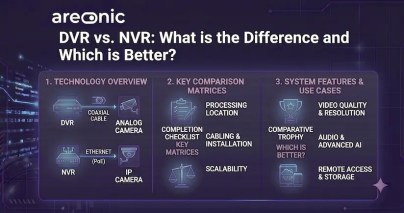
DVRs and NVRs are hardware-centric recording appliances; a VMS is a software-centric management layer. The distinction matters because hardware-centric systems are frequently proprietary the recorder, cameras, and viewing software come from one vendor and interoperate poorly with anything else. A VMS, particularly one built on open standards such as ONVIF compliance, abstracts the management layer away from the recording hardware.
| DVR | NVR | VMS | |
|---|---|---|---|
| Category | Hardware appliance | Hardware appliance | Software platform |
| Camera type | Analog | IP cameras | Analog + IP (via encoders/bridges) |
| Camera interoperability | Low typically single-vendor | Moderate often vendor-limited | High open-platform, multi-vendor |
| Multi-site management | No per-device access | Limited | Native centralized across sites |
| Scalability | Fixed channel count | Fixed channel count per unit | Scales with licensing/subscription |
| Analytics | None or basic motion | Basic, device-dependent | Advanced AI and video analytics |
| Remote access | Limited, configuration-heavy | Moderate | Native web and mobile access |
| Failure exposure | Single point of failure on site | Single point of failure on site | Depends on architecture; cloud/hybrid add redundancy |
In enterprise practice, the two models are not mutually exclusive: many organizations retain existing NVRs as local recording hardware and layer a VMS on top for centralized management. Camera-agnostic platforms make this possible without hardware replacement for example, Areonic Bridge connects legacy NVRs and network cameras, and analog cameras to a cloud VMS, preserving prior hardware investment.
What features should you look for in a VMS?
Feature sets vary widely between platforms. The following capabilities have the greatest impact on total cost of ownership and operational efficiency at enterprise scale.
Scalability. Evaluate how the platform behaves as camera counts grow from 10 to 1,000+. Key questions: Is scaling constrained by per-server channel limits, or is the architecture horizontally scalable? What does adding a new site require new server hardware and licensing, or simply registering devices to an existing tenant? Cloud-native platforms with scalable architecture generally add sites and cameras without additional local infrastructure.
AI and video analytics. Modern platforms embed analytics that convert raw footage into searchable, actionable data: motion and intrusion detection, license plate recognition (LPR), facial recognition, object classification and tracking, people counting, and queue detection. Assess whether analytics run at the edge (on-camera), on-server, or in the cloud, and whether they require proprietary hardware. Platforms such as Areonic AI+ Suite apply these analytics across mixed camera fleets, which matters for organizations that cannot standardize on a single camera vendor.
Integration capabilities. A VMS delivers more value when video is correlated with other operational systems. Priority integrations include access control systems (ACS) linking footage to badge events fire and intrusion alarms, and POS systems for transaction-level video verification in retail and QSR environments. Verify the availability of documented APIs and pre-built connectors.
User interface and accessibility. Enterprise deployments require web-based consoles that do not depend on installed thick clients, mobile applications for field and regional staff, and true multi-site management: a single pane of glass covering every location, with role-based access control (RBAC) so users see only the cameras appropriate to their role.
Search and playback efficiency. Incident investigation time is a direct cost. Evaluate how quickly operators can locate a specific event: timeline scrubbing with motion indicators, filtered search by object type or region of interest, and export workflows that preserve chain of custody. Platforms with analytics-driven indexing reduce investigation time from hours of manual review to minutes of filtered search.
What are the different types of VMS platforms?
VMS architectures fall into three categories. Each carries distinct implications for TCO, security posture, and bandwidth planning.
On-premise VMS
All software, recording, and storage run on servers owned and operated by the organization, typically at each site or in a corporate data center.
- Advantages: Full control over data locality and infrastructure; no dependence on internet connectivity for recording or local viewing; suited to environments with strict data-residency requirements.
- Disadvantages: High initial CapEx (servers, storage arrays, licensing); ongoing maintenance burden patching, firmware updates, hardware refresh cycles falls entirely on internal IT; scaling to new sites means procuring and deploying new infrastructure; cybersecurity responsibility (hardening, monitoring, updates) is internal.
Cloud-based VMS (VSaaS)
Video Surveillance as a Service: the management platform, and typically storage, run in the provider’s cloud. Cameras connect directly or through a lightweight bridge device.
- Advantages: Predictable OpEx subscription model in place of CapEx; minimal local hardware footprint; automatic software and security updates; native remote access and multi-site management; provider-managed redundancy and infrastructure security. Adding a location is a configuration task rather than a deployment project the model behind cloud-native platforms such as Areonic Vision Cloud, which unifies cameras across all sites in one secure cloud environment.
- Disadvantages: Recording and access depend on upstream bandwidth per-camera bitrate must be planned against available connectivity; recurring subscription costs accumulate over long horizons; organizations with strict data-sovereignty constraints must verify the provider’s storage regions and compliance certifications.
Hybrid VMS
Video is recorded locally on existing NVRs, edge storage, or on-site appliances while the cloud layer provides centralized management, remote access, analytics, and selective cloud backup.
- Advantages: Combines local recording reliability (footage continues recording during internet outages) with cloud accessibility and analytics; preserves existing recorder investments; reduces upstream bandwidth requirements since full-resolution streams remain local.
- Disadvantages: More complex architecture than either pure model; local hardware still requires some maintenance; capabilities depend on how deeply the platform integrates with third-party recording hardware.
For multi-site enterprises with heterogeneous legacy equipment, hybrid is frequently the lowest-friction migration path: existing infrastructure keeps recording while management moves to the cloud.
How to Choose the Right VMS for Your Business
A structured evaluation prevents both over-buying and costly re-platforming. Work through the following steps:
- Audit existing infrastructure. Document every camera (analog vs. IP, manufacturer, resolution), recorder, and network segment per site. This inventory determines whether candidate platforms can absorb current equipment or will force replacement.
- Verify camera compatibility and ONVIF compliance. Confirm that the platform supports your device list either through ONVIF profiles or documented direct integrations. Open-platform support is the primary defense against vendor lock-in and proprietary hardware dependence.
- Define storage and retention requirements. Calculate retention needs per camera based on regulatory obligations, insurance requirements, and investigation windows. Retention policy drives storage sizing and is a major cost variable in both on-premise and cloud models.
- Evaluate cybersecurity standards. Require encryption in transit and at rest, MFA, RBAC, audit logging, and evidence of independent assessment such as SOC 2 compliance. A camera network is an attack surface; the VMS is its control plane.
- Model total cost of ownership over 3–5 years. Include licensing or subscription, storage, server refresh (on-premise), bandwidth upgrades (cloud), and internal IT labor. The cheapest year-one option is frequently not the cheapest at year five.
Run a scoped pilot one representative site, real cameras, real users before committing to an enterprise rollout.
Video management software is the control plane of modern surveillance: it determines whether an organization’s cameras function as isolated recording devices or as a unified, searchable, secure video infrastructure. For enterprises operating multiple sites particularly those with mixed legacy hardware the evaluation priorities are consistent: open-platform camera interoperability, verifiable cybersecurity standards, analytics that reduce investigation time, and an architecture whose cost model matches how the business actually scales.