
People Counting Camera Guide: Computer Vision, Analytics, and Retail Defense
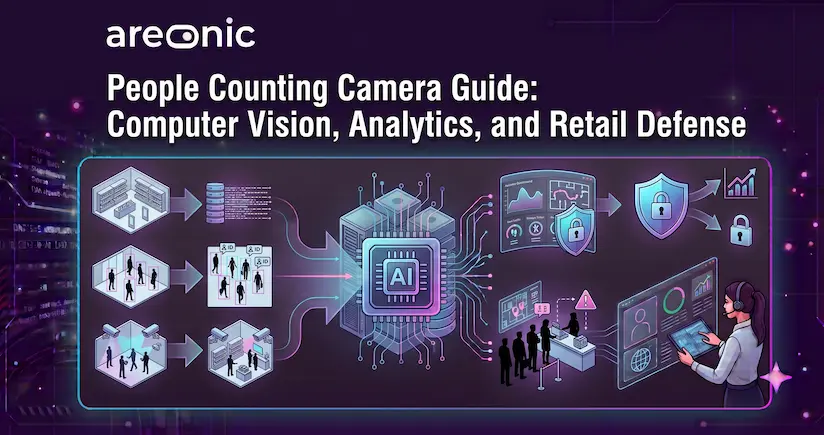
Retail directors carry two mandates that pull in opposite directions: protect inventory from organized retail crime while extracting granular foot-traffic data to optimize labor and merchandising. The same overhead camera can serve both, if the software behind it is doing more than recording. A people counting camera reads the store as spatial data, counting entries, measuring dwell, and flagging density anomalies in real time, which turns a passive feed into a live source of both loss-prevention signal and commercial telemetry. This guide covers the optical sensor options, the computer vision that tracks people across a scene, and how software-driven counting bridges retail store security and store analytics on one camera layer.
The Technological Evolution of People Counting in Retail Store Security
Retail store security is the combined hardware and software that protects a store’s inventory, staff, and customers, extended in modern deployments from passive recording into active analytics such as occupancy tracking and tailgating detection. Using a dedicated people counting camera sits at that intersection, using the same overhead cameras that watch for theft to measure how people actually move through the space.
Three sensor approaches dominate retail occupancy tracking, and they trade cost against depth accuracy.
- Monocular IP cameras with edge AI: Standard single-lens security cameras run deep learning bounding-box models to detect and track people, which is flexible and cost-effective because it reuses existing hardware. The trade-off is depth ambiguity in dense crowds, where overlapping bodies are harder to separate from a single viewpoint, though modern tracking models mitigate much of this by following motion vectors across frames rather than judging any single image.
- Stereoscopic 3D dual-lens sensors: Two lenses calculate parallax to build a depth matrix, which lets the system distinguish adults from children and shopping carts with accuracy above 98 percent. The depth data resolves exactly the crowding case that challenges a monocular view.
- Time-of-Flight (ToF) infrared optical arrays: ToF sensors measure the flight time of emitted infrared pulses to build a real-time 3D depth map, operating independently of ambient lighting. Because they read distance rather than appearance, they count reliably in a dim stockroom or a sunlit entrance alike.
Choosing among them is a question of budget against conditions, not a single best sensor. Monocular cameras with edge video analytics are the pragmatic default for most stores, because they reuse the overhead cameras already installed and reach strong accuracy in normal traffic. Stereoscopic and ToF sensors earn their premium only where depth is genuinely hard: high-density entrances, checkout crushes, or spaces with severe lighting swings. In practice many retailers standardize on monocular overhead occupancy monitoring across the floor and reserve depth sensors for a handful of problem zones, which keeps the deployment affordable without conceding accuracy where it counts.
The Dual Mandate: Unifying Operations and Retail Store Security Systems
Retail store security systems earn their return twice when the same people-counting layer feeds both asset protection and profitability. Four functions capture most of that dual value.
- Active perimeter and tailgating detection: Overhead people counts are cross-referenced against physical turnstile or access-door scans, so a piggybacking entry into a stockroom or employee-only area, one badge but two bodies, is flagged the moment it happens. Tailgating detection closes the gap a badge reader alone cannot see, which is often the route internal theft and unauthorized access actually take.
- Flash mob and group concealment alerts: The system watches for sudden surges in customer velocity and density at a storefront threshold, the signature of a coordinated smash-and-grab, and alerts loss prevention before the group reaches the merchandise. Detecting the pattern early is what buys the seconds that separate a deterred attempt from a cleared shelf.
- Dynamic checkout queue and staff optimization: Continuous measurement of dwell time and queue length at POS clusters lets the system dispatch staff to registers as lines build, cutting the friction and abandoned-basket walkouts that long queues produce. Queue length optimization turns a labor guess into a live signal.
- Conversion rate analytics: Correlating door entry counts with POS transaction logs yields a true conversion rate and foot-traffic density per aisle, so merchandising and marketing are measured against actual traffic rather than sales alone. The security camera becomes a source of commercial truth.
What ties these four together is that they run on one data stream. The same anonymized count that flags a tailgating event also measures the checkout queue and feeds the conversion dashboard, so loss prevention and operations stop paying for separate systems that observe the same customers. That shared layer is the practical case for treating people counting as infrastructure rather than as a point tool bought for a single purpose.
The Areonic Advantage: Pure Software Over Dedicated Counting Hardware
Dedicated people-counting hardware treats counting as a separate system with its own sensors, its own cabling, and its own bill. Areonic treats it as an analytic that runs on cameras a store already has, and the difference shows up in three places.
Hardware is the first. Legacy providers require retailers to buy dedicated, single-purpose counting appliances for every doorway and zone, which multiplies a specialized device across the floor plan. Areonic runs as a software layer on standard enterprise servers, ingesting overhead video from any pre-existing ONVIF-compliant IP camera, so the camera already watching the entrance becomes the counter.
Privacy is the second, and in retail it is a compliance question rather than a preference. Dedicated hardware often stores identifiable facial features locally, creating standing GDPR and PII exposure that a loss-prevention program does not want to own. Areonic processes frames at the edge and converts each person into anonymized numerical vector coordinates, extracting and retaining no personally identifiable information, so the analytics exist without the liability. The distinction matters to legal and IT sign-off as much as to operations, because a counting system that never captures identity is far easier to deploy across jurisdictions with differing privacy law.
Bandwidth is the third. Streaming continuous overhead video to a cloud analytics provider chokes the same store connection running the POS and guest Wi-Fi. Areonic executes neural network inference locally, keeps full-resolution video on site, and sends under one percent of network bandwidth as JSON metadata to central retail BI, so counting never competes with the register.
Read together, the three advantages describe the same shift: counting stops being a device a retailer buys and becomes a capability the existing camera layer already has. For a multi-store operator, that turns the rollout from a per-door hardware project into a software deployment that scales across the estate at the pace of configuration rather than procurement.
Conclusion
A people counting camera is worth deploying because it collapses two budgets into one sensor: the loss-prevention camera and the analytics sensor become the same overhead feed, read by software instead of a dedicated appliance. The optical choice, monocular, stereoscopic, or Time-of-Flight, sets the depth accuracy, but the value comes from what the computer vision does with the frame: counting entries, timing queues, flagging tailgating and density surges, and correlating traffic with sales. Areonic delivers all of it as camera-agnostic, privacy-preserving software that keeps video and PII local while feeding anonymized metadata to central dashboards. Retail and loss-prevention leaders can request a technical architecture briefing to map people counting onto their existing overhead cameras and POS.