What Is an AI Data Security Platform? Architecture, Governance, and Threat Ingestion

Enterprise data governance stops at the loading dock. Digital applications enforce strict access control, audit logging, and encryption on every record, while the physical security layer, video feeds, access-badge scans, and perimeter radar, generates terabytes a day that sit in unindexed silos no data policy ever touches. That gap is both a blind spot and a liability, because the richest behavioral data in the building is also the least governed. An ai data security platform closes it by pulling physical telemetry into the same data plane the rest of the enterprise already secures. This article defines what an ai security platform is at the architectural level, how it ingests physical-cyber telemetry safely, and how governance is enforced end to end.
The Architectural Anatomy of an AI Data Security Platform
An ai data security platform is a system that ingests, sanitizes, governs, and analyzes high-throughput security data from disparate digital and physical sources under a single policy framework. It applies machine learning inference and policy-as-code access rules to detect multi-vector threats in real time without exposing the underlying sensitive data it processes, a model often described as an AI security platform, or AISP, framework.
The platform is built from three tiers that together turn raw sensor output into governed, queryable intelligence. Each handles a distinct stage: getting the data in cleanly, deciding who may touch it, and finding the threats inside it.
- The data ingestion and sanitization tier: High-throughput streaming pipelines ingest raw video (RTSP and ONVIF), access-controller event logs, and IoT telemetry without introducing packet loss, then normalize and sanitize them into a common structure. This sensor telemetry pipeline is where unstructured physical output becomes data the rest of the platform can reason over.
- The contextual policy and authorization engine: Access logic is decoupled from application code using a policy-as-code architecture, in the mold of the Cerbos model, with attribute-based access control (ABAC) governing who may view, query, or export any given piece of video metadata. Because policy lives outside the application, it can be audited, versioned, and changed without redeploying the system.
- The continuous threat inference tier: Machine learning classifiers run real-time pattern recognition across multi-source data vectors, correlating video, access, and sensor signals to flag both policy violations and active physical threats. This tier is what makes the platform proactive rather than a passive archive.
The tiers matter because of the order they impose. Data is sanitized before it is stored, governed before it is queried, and analyzed before it is escalated, so there is no point in the pipeline where raw, ungoverned video is simply sitting exposed. That sequencing is the difference between a surveillance system that happens to use AI and a genuine data security platform: the second one can prove, at every stage, who touched which record and under what policy.
Solving the Physical-Cyber Threat Gap: Ingesting Edge Telemetry Safely
Bringing raw surveillance data into an enterprise IT environment is only safe if the ingestion itself does not create new exposure. Physical-cyber convergence works when three requirements are met at the edge.
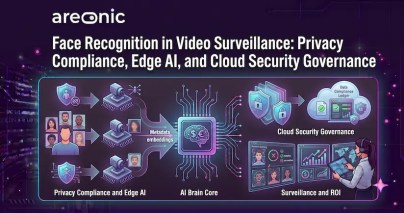
- Edge-computed data sanitization: Neural network inference runs locally to convert multi-gigabyte video streams into structured, lightweight text metadata, so sensitive visual records stay inside the local network perimeter while only edge-computed metadata moves onward. The raw video never has to leave the building to be useful.
- Cryptographic transport and data isolation: TLS 1.3 encrypts every internal data bus, and the architecture requires zero inbound firewall ports, which closes the exact vector IoT botnets exploit to reach camera fleets. Nothing about the deployment is directly reachable from the internet.
- Zero-trust identity federation: Physical-security queries integrate with enterprise identity providers over SCIM and SAML, so multi-factor authentication and least-privilege apply to video and access data exactly as they do to any other governed system. A zero-trust data plane treats a camera feed with the same rigor as a production database.
The Areonic Advantage: Transforming Sensor Noise into Governed Intelligence
The distinction that matters is whether a system treats video as footage or as data. Legacy VMS and generic AI monitoring tools treat it as footage, something to store and occasionally review; an AI security platform treats it as governed data, and that reframing is exactly what Areonic operationalizes.
Governance starts at ingestion. Closed providers lock enterprises into proprietary cameras and single-vendor appliances that were never built with modern cybersecurity controls, so the data enters ungoverned from the first frame. Areonic runs as a hardware-agnostic software layer that unifies any existing ONVIF camera network under one centrally managed data plane, so governance applies uniformly regardless of what hardware produced the stream.
Retrieval is the second test of whether video is really data. Footage-based systems make an operator scrub disparate DVR timelines by hand; a data platform answers a question instead. Areonic indexes cryptographically validated metadata, so a security architect queries in plain language, for example “unauthorized badge swipe at the server room after 10 PM,” and surfaces the verified clip in under two seconds.
Exposure is the third, and it is where footage-based models leak. Uploading raw video to a public cloud creates both network congestion and a standing compliance liability. Areonic performs computer vision algorithms and applications locally and moves under one percent of network bandwidth as metadata, so the sensitive data stays put and only governed, signed intelligence travels to the central console.Signing that metadata also matters for integrity, since a governed pipeline has to defend against tampered or poisoned inputs, not only against interception.
Compliance, Privacy, and Auditing: How an AI Security Platform Enforces Governance
Once physical data is governed like any other enterprise data, compliance stops being a manual project and becomes a property of the platform. An enterprise-grade ai security platform enforces it continuously rather than only at audit time.
Retention is automated: policy defines how long each class of footage and metadata is kept, held, or purged, so jurisdictional rules are enforced by the system instead of by a technician remembering to delete. Privacy is handled at the same layer, with PII redaction such as automated facial blurring applied to satisfy GDPR and comparable regimes before footage is ever shared or exported.
Auditability closes the loop. Every operator action, each query, view, and export, is written to an immutable log, so continuous compliance auditing can reconstruct exactly who saw what and when. Building to SOC 2 Type II controls and NDAA federal standards keeps the deployment both defensible under review and eligible for regulated and public-sector procurement. Governance, in other words, is not a report the platform produces at quarter-end; it is how the platform runs every day.
Conclusion
The most valuable behavioral data an enterprise holds has historically been its least governed, sitting as raw footage outside every policy the rest of the business enforces. An AI data security platform corrects that by treating physical telemetry as governed data: ingested cleanly, gated by policy-as-code and ABAC, analyzed at the edge, and audited end to end. Areonic delivers this for visual and physical sensor data specifically, keeping video local, emitting only signed metadata, and bringing camera fleets and access systems under the same zero-trust governance as the digital estate. CISOs and security architects can request a technical architecture briefing to map the platform onto their existing sensors, identity providers, and SIEM.