What is a Vendor Management System (VMS)? Definition, Benefits, and Processes
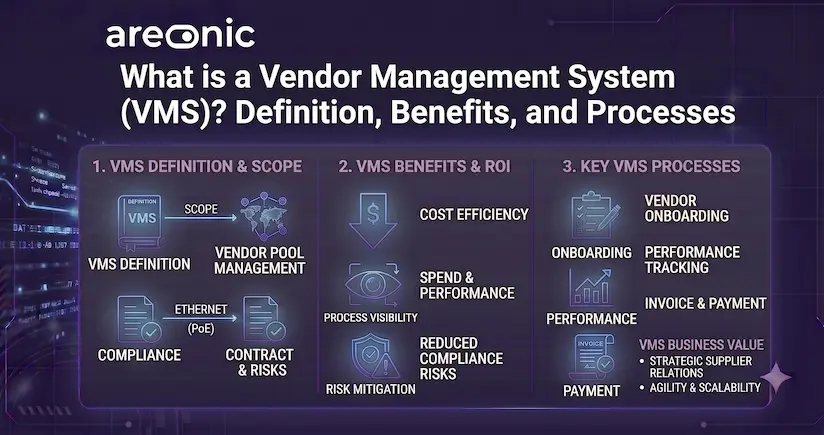
Every organization that buys goods or services relies on outside vendors, and past a certain scale, running those relationships out of spreadsheets and email inboxes stops working. A vendor management system is the software layer that replaces that scramble with one structured way to source, contract, pay, and evaluate every supplier. This guide explains what a vendor management system is, the processes it manages, the value it delivers, and how to judge whether your organization needs one.
A quick note on the acronym first. VMS also stands for video management software in the physical security world, which is a different category entirely. This article is about vendor management systems: the procurement and supplier-oversight platforms used by finance, procurement, and HR teams.
Definition
A vendor management system is a centralized platform for managing the entire relationship between an organization and its external vendors, from first contact through offboarding. It holds vendor records, automates procurement and approval workflows, tracks contracts and compliance obligations, and measures supplier performance against agreed terms. In staffing and contingent-workforce settings, the same term describes software that manages temporary labor, suppliers, and staffing agencies through a single requisition-to-payment flow.
The idea underneath every version is consolidation. Rather than letting vendor data scatter across finance, legal, and individual department systems, a vendor management system gives everyone who touches a supplier one shared source of truth.
How a vendor management system works
Most platforms are built around a central vendor database, and everything else hangs off it. When a new supplier is added, their tax details, banking information, certifications, and contract terms are captured once and reused everywhere, so a purchase order, a compliance check, and a payment all draw on the same underlying record.
Around that database sit a handful of working parts. Onboarding tools collect documentation and route it for approval. A contract repository stores agreements with renewal dates and key clauses surfaced automatically. Workflow automation moves requests through the right approvers instead of relying on someone to forward an email. Spend tracking rolls individual transactions up into a view of what the organization actually pays each vendor. Performance scorecards turn service-level agreements into measurable ratings. Integrations connect all of this to the accounting or ERP system so numbers do not have to be rekeyed.
The vendor management process
Where the software earns its place is in giving a repeatable shape to what is otherwise an ad hoc process. A typical lifecycle runs through six stages.
It starts with sourcing and selection, where potential suppliers are identified, compared, and shortlisted against cost, capability, and risk. Onboarding follows: collecting compliance documents, verifying credentials, and setting the vendor up in finance systems. Contracting formalizes the terms, and a good platform keeps that contract findable rather than buried in someone’s drive.
Once the vendor is live, the emphasis shifts to ongoing management, tracking deliverables, quality, and responsiveness against the agreement. Running alongside that is risk and compliance monitoring, which watches for expiring insurance, lapsed certifications, or regulatory exposure before they become problems. Finally comes renewal or offboarding, where the organization decides whether to extend, renegotiate, or cleanly exit, revoking access and closing out obligations.
Benefits
The clearest payoff is cost control. When every vendor and every transaction lives in one place, duplicate suppliers, maverick spend, and missed discounts become visible, and that visibility is leverage at renewal time.
Risk reduction is the second major gain. Centralized tracking of certifications, insurance, and regulatory requirements means compliance gaps get caught early rather than discovered during an audit. Efficiency is the benefit people feel day to day: automated workflows remove the manual chasing that eats procurement teams’ time. And because performance is measured rather than remembered, vendor relationships rest on data both sides can see, which makes conversations about quality and renewal far more productive.
Signs you have outgrown manual vendor tracking
There is usually a moment when the informal system stops holding. It shows up as the same vendor set up twice under slightly different names, as a renewal that lapsed because the date lived in one person’s calendar, or as an audit request that takes days to answer because the supporting documents are scattered across inboxes. Other signs are quieter: no one can say with confidence how much the organization spends with its ten largest suppliers, or a department keeps buying from a vendor that procurement believed had been retired. Individually these are minor irritations. Together they indicate that vendor data has outgrown the tools holding it, and that the cost of not having answers, measured in wasted hours, missed savings, and compliance exposure, has started to rival the cost of the software that would provide them.
How it differs from related tools
A vendor management system is often confused with adjacent software, and the distinctions matter when you are building a shortlist. Procurement or procure-to-pay platforms focus on the buying transaction itself, purchase orders through to payment, while a VMS spans the whole relationship including performance and risk. A managed service provider (MSP) is a service, not software, though MSPs frequently operate a VMS on a client’s behalf, most often for contingent labor. ERP suites may include vendor modules, but these tend to prioritize financial records over supplier performance and lifecycle management. Many organizations run a dedicated VMS precisely because their ERP treats vendors as accounting entries rather than relationships to be managed.
Choosing a vendor management system
The right platform depends less on feature counts than on fit. Weigh how well it integrates with the finance or ERP system you already run, since a VMS that cannot exchange data cleanly creates more work than it saves. Look at whether its compliance and risk features match your regulatory environment, whether the workflow engine is flexible enough for your approval structure, and whether the reporting gives leadership the spend and performance views they will actually ask for. For organizations managing temporary labor, contingent-workforce capabilities are worth weighting heavily, as that is a specialized corner of the market.
Where vendor management meets physical operations
For multi-location businesses, restaurants, retail chains, and franchises among them, a large share of vendors do their work on site: maintenance crews, cleaning contractors, merchandisers, and security providers. Confirming that this work actually happened, and happened to standard, across dozens or hundreds of locations is its own oversight problem that a procurement record cannot answer on its own.
This is where operational visibility complements vendor management. A cloud video platform such as Areonic Vision Cloud lets corporate teams verify on-site vendor activity remotely, from a single dashboard, without traveling to each location. Because existing cameras connect through Areonic Bridge rather than requiring new hardware, that verification layer can sit on top of the equipment a business already owns, turning vendor accountability from a trust exercise into something operators can actually see.
Conclusion
A vendor management system takes the sprawl of supplier relationships, contracts, spend, compliance, and performance, and gives it a single structured home. For organizations past the spreadsheet stage, the return shows up as tighter cost control, fewer compliance surprises, and vendor conversations grounded in data rather than memory. The best choice is the one that fits your existing finance stack and your real approval workflows, not the one with the longest feature list. And for operators whose vendors work across physical locations, pairing that procurement discipline with remote operational visibility closes the loop between what a contract promises and what actually happens on the ground.