
AI Smoke and Fire Detection: The Evolution of Early Fire Alarm Systems for Business
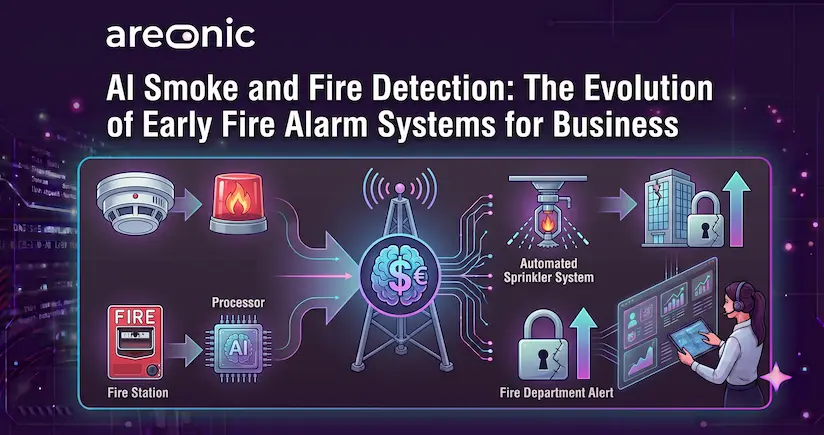
Commercial fire detection has a physics problem that no amount of sensor quality fixes. A traditional fire alarm for business relies on smoke particles physically reaching a ceiling-mounted chamber, or heat reaching a probe, and in a high-bay warehouse, an open loading yard, or a floor with strong HVAC airflow, that can take minutes the building does not have. The delay is not a device failure but a consequence of thermal stratification and air movement. Computer vision changes the terms: instead of waiting for combustion products to travel to a sensor, it detects the optical signature of smoke and flame across the space at the speed of light. This guide explains why a legacy fire alarm system for business struggles in industrial environments and how visual analytics close the latency gap.
The Physical Limitations of a Legacy Fire Alarm System for Business
A fire alarm system for business is the network of initiating devices, notification appliances, and a control panel that detects a fire and warns occupants and responders, governed in the United States by NFPA 72. Its effectiveness depends entirely on a physical condition being met at the sensor, smoke reaching a chamber or heat reaching a probe, which is precisely where large industrial spaces expose its limits.
The core devices, photoelectric and ionization smoke detectors and thermal heat probes, are reliable in enclosed rooms at normal ceiling heights. Two conditions common in industrial facilities defeat them, and both are physical rather than electronic.
The Thermal Stratification Bottleneck
In facilities with ceilings above roughly 30 feet, smoke rising from a fire cools as it climbs and reaches a point of neutral buoyancy well below the roofline. There it spreads into a flat layer instead of continuing upward, a phenomenon known as high-ceiling stratification, and ceiling-mounted photoelectric or ionization sensors sit above that layer in air the smoke never reaches. The detector is working perfectly; the smoke simply never arrives, and the fire can grow for minutes before enough product finally penetrates to the ceiling.
Outdoor, Semi-Enclosed, and High-Airflow Challenges
Open loading bays, chemical yards, and floors served by high-velocity HVAC present the opposite failure. Here air movement dilutes and disperses smoke before its concentration at any single point sensor crosses the alarm threshold, so a genuine fire is fanned away from the very device meant to catch it. Point detection assumes still air and a rising plume; industrial airflow violates both assumptions, which is why open and semi-enclosed spaces are chronically under-protected by conventional detection.
How Computer Vision Transforms Smoke and Fire Detection
Visual detection removes the travel time entirely, because it watches the fire rather than waiting for its byproducts. Modern smoke and fire detection runs three complementary optical models at the network edge.
- Volumetric smoke plume analysis (VISD): Neural networks evaluate edge-stream frames for the directional expansion, color shift, and opacity change that characterize a developing smoke plume, trained to separate real smoke from steam, fog, and industrial dust. Video Image Smoke Detection reads the plume’s behavior across successive frames rather than a single image, which is what makes the discrimination reliable.
- Dynamic optical flame recognition (VIFD): Algorithms parse the raw feed for the flicker frequency characteristic of open flame, typically 1 to 10 Hz, together with the luminous intensity shifts a fire produces, identifying combustion in milliseconds. Video Image Flame Detection keys on these optical flame signatures instead of heat, so it triggers the instant a flame is visible.
- Radiometric thermal threshold tracking: Paired with dual-spectrum thermal cameras, the platform watches surface temperatures for abnormal build-up and thermal runaway, in a lithium-ion battery stack or an overheating bearing, well before visible combustion begins. Thermal imaging analytics catch the pre-fire condition, not only the fire itself.
The Areonic Edge: Upgrading Fire Alarm for Business Operations
Legacy detection is gated by physics; optical detection is gated only by line of sight. That is the difference Areonic operationalizes, running VISD and VIFD as a camera-agnostic software layer on the cameras a facility already owns.
Speed is the most consequential gain. A point detector in a large space can take minutes to accumulate enough smoke to trip, and in a stratified or drafty building it may never trip at all. Areonic evaluates visual and thermal patterns as light reaches the lens, flagging an incipient plume or an open flame in under three seconds at the network edge, which in a fast-developing industrial fire is the margin between a contained incident and a total loss.
Deployment cost is the second. Specialized aspirating systems such as VESDA extend detection into difficult spaces, but they do it with networks of sampling pipe that must be engineered, installed, and maintained. Areonic adds equivalent early coverage in software on existing ONVIF IP and thermal cameras, which removes most of that CapEx along with the recurring maintenance a piping network carries.
The third gain is fewer false alarms, which in industry are not a nuisance but a direct cost. Dust, exhaust, and steam routinely trip legacy detectors, and each unplanned evacuation or municipal false-dispatch fine is expensive. Areonic cross-references multi-frame motion and thermal vectors to distinguish benign clouds from real combustion with roughly 95 percent accuracy, cutting shutdowns without lowering sensitivity to genuine events.
None of this replaces the code-mandated system. Areonic runs as an early-warning and verification layer alongside the NFPA 72 fire alarm system a facility is legally required to maintain, buying the minutes that certified life-safety equipment, triggered later by physical smoke, cannot.
Industrial and Enterprise Use Cases for Visual Fire Analytics
The value of visual detection is clearest in exactly the environments where point sensors fail.
High-bay warehousing and logistics hubs are the canonical case. Cavernous vertical racking creates the stratification barrier described earlier, and beam-mounted cameras watching the aisles detect a plume at its source instead of waiting for smoke that may never reach the roof deck.
Waste management and recycling facilities face a different threat: spontaneous hot spots and lithium-ion battery fires buried in open refuse piles. Thermal analytics identify a heat anomaly inside a pile before it flares into open combustion, which is frequently the only warning such fires give.
Manufacturing plants and chemical storage combine both problems at higher stakes. Visual and thermal models track flammable-liquid leaks, monitor high-heat machinery zones, and watch outdoor tank farms where no enclosed sensor could realistically be placed, extending industrial fire prevention to spaces conventional detection cannot cover.
Conclusion
Traditional fire detection is only as fast as the smoke is willing to travel, and in high-bay, outdoor, and high-airflow industrial spaces that speed is dangerously low. Computer vision removes the dependency entirely, reading the optical signature of smoke and the flicker of flame across a whole facility in seconds rather than waiting for particles to reach a chamber. Areonic delivers this as VISD and VIFD software on existing IP and thermal cameras, adding sub-three-second early warning, cutting industrial false alarms, and doing it alongside, not instead of, the NFPA 72 system a business must keep. Facility and EHS leaders can request a technical architecture briefing to map visual fire analytics onto their existing cameras and highest-risk zones.