Best Video Management System (VMS) Platforms: Enterprise Software Comparison
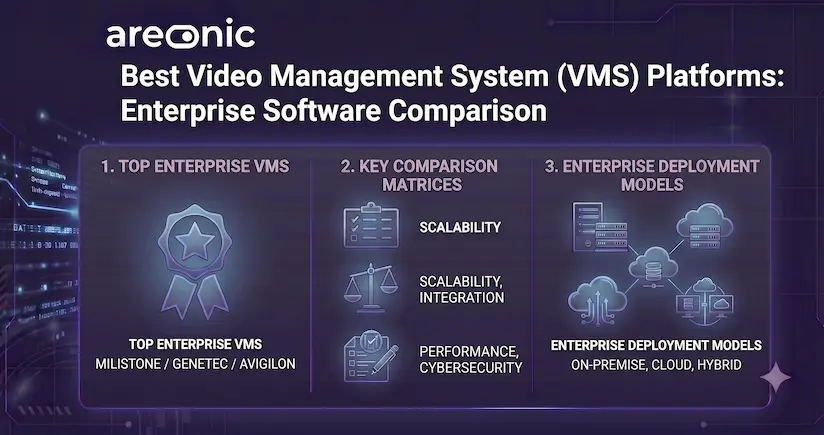
Selecting a video management system is a long-horizon infrastructure decision: the platform you choose determines your camera compatibility, your storage economics, and your operational visibility for the next five to ten years. The market offers dozens of options built on fundamentally different architectures – proprietary cloud ecosystems, open on-premise platforms, and camera-agnostic hybrid systems. This comparison evaluates leading enterprise VMS platforms against the criteria that drive total cost of ownership and day-to-day usability, so you can shortlist based on how your organization actually operates.
One clarification before the comparison: this guide covers surveillance VMS – software that manages security cameras, recording, and video analytics. It does not cover enterprise video content platforms (Kaltura, Brightcove, Panopto), which manage corporate media libraries and streaming and occupy an entirely different category despite the similar name.
Evaluation criteria
Each platform below is assessed against five factors that consistently separate enterprise deployments that scale smoothly from those that require costly re-platforming:
- Deployment model – cloud-native (VSaaS), on-premise, or hybrid
- Camera compatibility – open platform vs. proprietary hardware requirements
- Multi-site management – how well the platform centralizes administration across locations
- AI and video analytics – native capabilities for search, detection, and operational intelligence
- Cost model – CapEx vs. OpEx, and what scaling to a new site actually costs
Quick comparison
| Platform | Deployment | Camera compatibility | Best fit |
|---|---|---|---|
| Areonic | Cloud / hybrid | Open works with existing cameras and NVRs | Multi-location QSR, retail, franchise operations |
| Verkada | Cloud | Primarily Verkada cameras; limited third-party via Command Connector | Organizations standardizing on new hardware |
| Eagle Eye Networks | Cloud | Open broad third-party support | Distributed enterprises with mixed camera fleets |
| Rhombus | Cloud | Best with Rhombus hardware; supports third-party via ONVIF/RTSP | Enterprises wanting an integrated cloud ecosystem |
| Milestone XProtect | On-premise / hybrid | Open widest device integration | Large campuses, critical infrastructure |
| Genetec Security Center | On-premise / hybrid | Open | Enterprises unifying video with access control |
| Avigilon (Unity / Alta) | On-premise or cloud | Strongest with Avigilon hardware | High-security environments with demanding search needs |
| Spot AI | Cloud / hybrid | Open works with existing IP cameras | Teams prioritizing AI search on current hardware |
1. Areonic
Areonic is a cloud-native, camera-agnostic video management system built for multi-location businesses – particularly QSR, retail, and franchise operations. Its architecture centers on a simple premise: enterprises should not have to replace working cameras to modernize video management. Existing NVRs and network cameras connect to Areonic Vision Cloud through a bridge device, bringing every site into a single cloud dashboard.
Strengths: No rip-and-replace – legacy NVRs and network cameras connect via Areonic Bridge in minutes, which keeps deployment costs low and rollout timelines short. Multi-site management is the core design goal rather than an add-on: one interface covers every location, with role-based access for store, regional, and corporate users. The AI+ Suite adds operational analytics – queue detection, people counting, traffic patterns – that extend the platform beyond security into operations and loss prevention.
Considerations: Focused on the multi-location commercial segment rather than government or critical-infrastructure deployments that demand highly customized on-premise architectures.
Best for: Multi-location operators restaurant groups, retail chains, franchises that want centralized cloud video and operational analytics without replacing existing camera investments.
2. Verkada
Verkada is one of the most visible cloud-first security platforms, combining cameras, access control, sensors, and alarms in a single ecosystem managed through its Command platform.
Strengths: Tight hardware-software integration produces a polished user experience and fast deployment when starting from zero. The unified ecosystem (video, doors, sensors) appeals to organizations consolidating physical security under one vendor.
Considerations: The proprietary model is the defining trade-off: while Command Connector now supports select third-party cameras, the platform is designed around Verkada hardware and per-camera licensing. Organizations with existing camera fleets typically need to replace hardware to get the full experience, and license costs compound across large estates.
Best for: Organizations building new or fully refreshing their physical security stack and willing to standardize on a single vendor.
3. Eagle Eye Networks
Eagle Eye Networks is a true cloud VMS with a long-standing open-platform position, supporting a wide range of third-party camera models through on-site bridges.
Strengths: Broad camera interoperability and a mature, API-first cloud platform. Well suited to distributed enterprises with heterogeneous equipment across sites.
Considerations: The experience depends partly on integrator quality, and analytics capabilities, while improving, have historically trailed AI-first entrants.
Best for: Distributed enterprises with mixed camera fleets that want a proven cloud VMS delivered through an integrator channel.
4. Rhombus
Rhombus is a cloud-native physical security platform combining video, access control, sensors, and alarm monitoring, with an emphasis on AI-powered detection across sites.
Strengths: Modern interface, strong native AI (person/vehicle detection, search), and a consolidated ecosystem approach similar to Verkada but with a more open trajectory on third-party devices.
Considerations: The platform is designed around Rhombus cameras and delivers full analytics on them; third-party cameras are supported via ONVIF/RTSP with a narrower feature set, so organizations with large legacy fleets should validate coverage against their specific inventory.
Best for: Enterprises that want a modern, integrated cloud security ecosystem and are comfortable adopting the vendor’s hardware for most coverage.
5. Milestone XProtect
Milestone’s XProtect is the reference open-platform VMS: on-premise software with the industry’s widest third-party device integration, now extending into hybrid cloud.
Strengths: Unmatched device and integration ecosystem, deep configurability, and proven scalability from small sites to thousands of cameras. Flexible licensing tiers match a wide range of deployment sizes. The open architecture is the strongest available defense against vendor lock-in.
Considerations: On-premise heritage means real infrastructure ownership: servers, storage, patching, and skilled administration. TCO is dominated by internal IT effort.
Best for: Large campuses, critical infrastructure, and enterprises with dedicated security IT teams that need maximum configurability.
6. Genetec Security Center
Genetec Security Center is a unified physical security platform combining VMS (Omnicast), access control, ALPR, and intrusion monitoring in one on-premise or hybrid system.
Strengths: True unification of video and access control at enterprise depth, strong cybersecurity posture and compliance credentials, and open architecture across a large certified device ecosystem. A standard choice for critical infrastructure and large multi-campus enterprises.
Considerations: Enterprise-grade complexity and cost: deployment typically involves certified integrators, meaningful infrastructure, and longer implementation timelines than cloud-native alternatives.
Best for: Security-mature enterprises unifying video, access control, and ALPR under one platform with dedicated administration.
7. Avigilon (Unity and Alta)
Avigilon, part of Motorola Solutions, offers two lines: Unity (on-premise) and Alta (cloud), paired with high-resolution cameras and advanced appearance-search analytics.
Strengths: Exceptional video quality and search – appearance search across cameras is a genuine investigation accelerator.
Considerations: The platform delivers full value with Avigilon hardware, and premium hardware carries premium cost. Organizations seeking camera-agnostic economics will find the model less flexible.
Best for: High-security environments – critical facilities, large venues – where investigation speed and image quality justify premium hardware.
8. Spot AI
Spot AI positions itself as an AI camera system that works with existing IP cameras, layering modern video intelligence on current infrastructure.
Strengths: Strong AI search and dashboarding on third-party cameras, straightforward deployment with an on-site appliance, and a value proposition aimed squarely at avoiding hardware replacement.
Considerations: Younger platform with a smaller enterprise track record than the established players; large deployments should validate scale and integration requirements.
Best for: Mid-market and growing enterprises that want AI-powered video on existing cameras with minimal disruption.
How to choose between them
The shortlist almost always comes down to two questions:
- What happens to your existing cameras? If you have working equipment across sites, camera-agnostic platforms (Areonic, Eagle Eye, Milestone, Spot AI) preserve that investment. Vendor-first ecosystems (Verkada, Rhombus, Avigilon) trade broader hardware freedom for tighter integration with their own devices.
- Who runs the system? Cloud-native platforms shift maintenance, updates, and infrastructure security to the vendor – decisive for organizations without dedicated security IT. On-premise platforms (Milestone, Genetec) reward teams that can operate them with deeper control.
For multi-location commercial operators specifically – restaurants, retail, franchises – weight multi-site usability and per-site rollout cost above raw feature count. A platform that adds a new location in an afternoon, on cameras you already own, compounds its advantage with every site you open.
There is no single best video management system – there is a best fit for your architecture, your camera estate, and your team. Established on-premise platforms still anchor the most demanding security environments, proprietary cloud ecosystems reward greenfield standardization, and camera-agnostic cloud platforms now offer multi-location businesses enterprise capability without enterprise infrastructure. Start from your existing hardware and your operating model, and the shortlist writes itself.